Dr. Lisa Funnell
Award-Winning Author | Media Educator & Consultant | “Dr 007” | Director of Communications, G-Woman Media

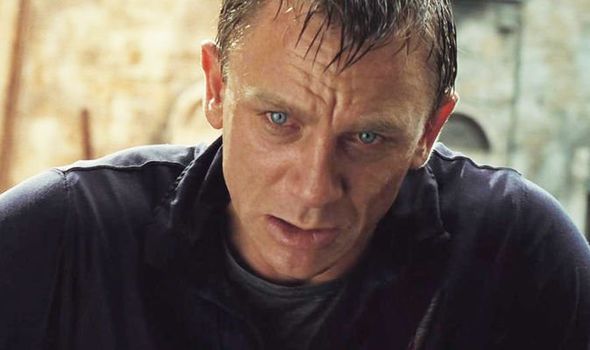
James Bond is often remembered as cinema’s ultimate stoic. He kills without hesitation, survives impossible odds, and moves seamlessly from one mission to the next. Death is an occupational hazard in the world of 007, and Bond is frequently criticized for appearing emotionally detached from the violence that surrounds him. His ability to compartmentalize has become synonymous with professionalism, resilience, and a particular model of cinematic masculinity.
Yet this popular perception overlooks one of the franchise’s most enduring emotional threads: grief. James Bond does grieve, but unlike many action heroes, he rarely leaves that grief behind. Rather than expressing loss through emotional monologues or overt displays of vulnerability, Bond mourns through memory, ritual, silence, and action. Across more than sixty years of storytelling, the Bond franchise repeatedly returns to its defining losses, allowing grief to accumulate rather than disappear. In doing so, grief becomes one of the series’ primary mechanisms of emotional continuity, linking otherwise episodic adventures across multiple actors, creative teams, and generations of audiences.
Tracy di Vicenzo: The Beginning of Bond’s Greatest Loss
If there is one defining moment in Bond’s emotional life, it is the death of Tracy di Vicenzo at the conclusion of On Her Majesty’s Secret Service (1969).
Unlike many Bond women who preceded her, di Vicenzo is given the opportunity to develop into a fully realized character. She challenges Bond, frustrates him, surprises him, and ultimately transforms him. Over the course of the film, audiences witness a relationship built not on seduction alone but on mutual respect, vulnerability, and genuine affection. By the conclusion, the seemingly impossible has happened: James Bond has fallen in love.
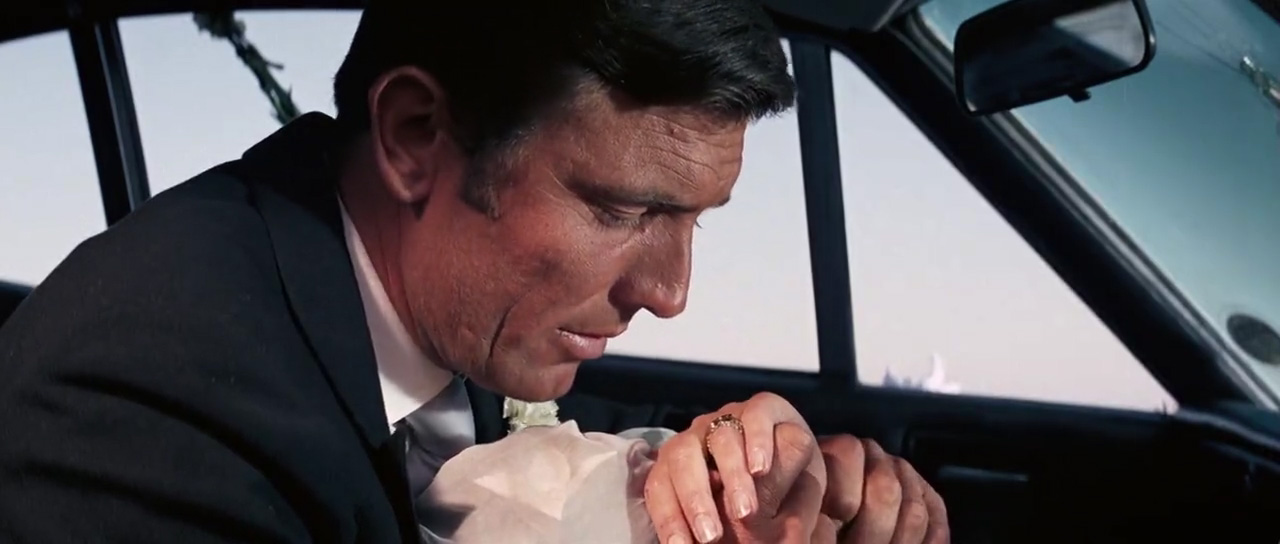
The tragedy of di Vicenzo’s death therefore extends beyond Bond’s personal loss. It becomes a moment of collective grief for the audience. Moments after their wedding, Ernst Stavro Blofeld and Irma Bunt gun down di Vicenzo, leaving Bond to cradle her body and quietly insist, “We have all the time in the world.” The line is devastating precisely because both Bond and the audience know they do not. The emotional power of the scene lies not simply in the death itself, but in the future that has been stolen before it could begin. Bond loses the woman he loves, but he also loses the possibility of marriage, domesticity, and a life beyond MI6.
The Spy Who Never Forgot
Most long-running action franchises would quietly move on from such a tragedy. The Bond franchise does something far more interesting.
More than a decade later, the pre-title sequence of For Your Eyes Only (1981) opens with Roger Moore’s Bond placing flowers on di Vicenzo’s grave. There is little dialogue and no dramatic explanation; Bond simply remembers. The sequence serves as a quiet act of mourning before Blofeld’s sudden reappearance transforms remembrance into resolution. The moment demonstrates that Bond’s grief has not disappeared simply because another mission has begun.
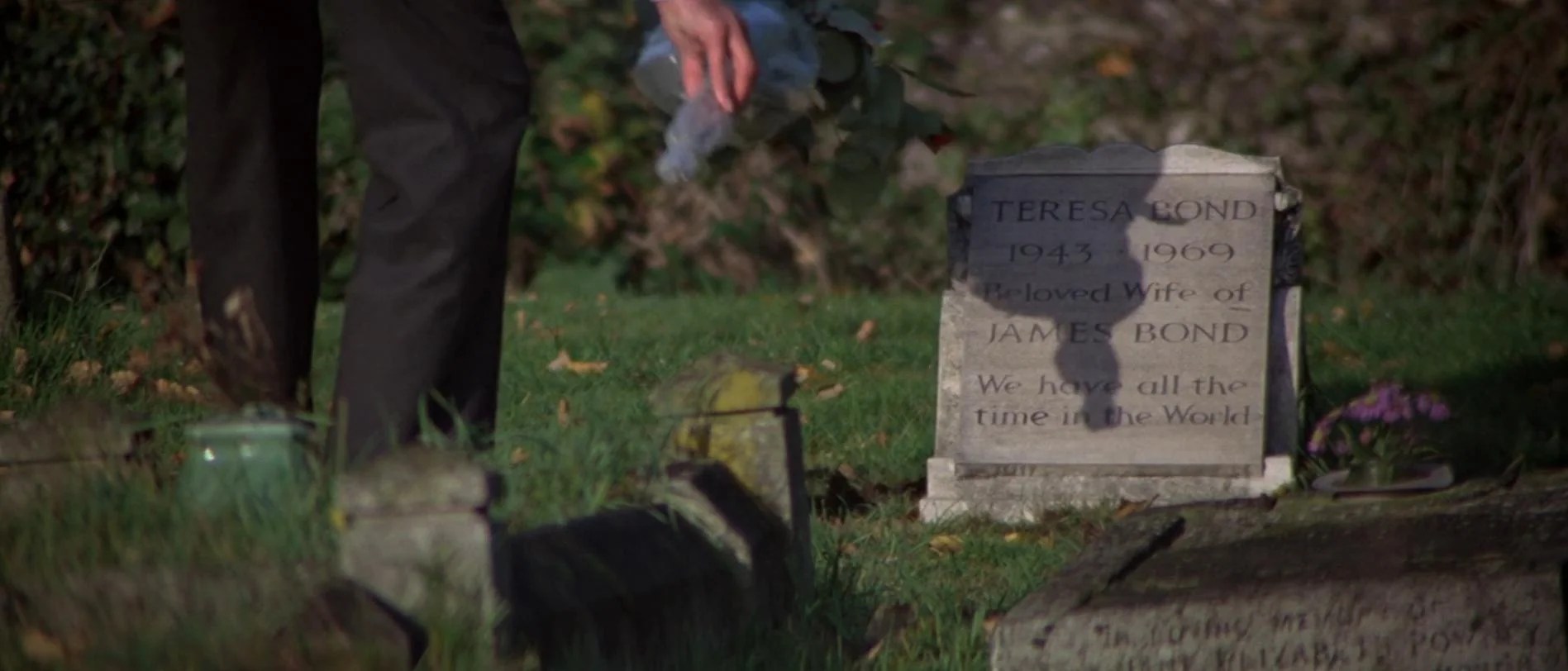
This brief sequence also reveals something remarkable about the franchise itself. Although James Bond is portrayed by a different actor and inhabits an episodic narrative, the films refuse to erase di Vicenzo’s significance. The franchise remembers alongside Bond, reinforcing the idea that some losses continue to shape a character long after the closing credits.
Weddings Become Trauma
Bond’s grief resurfaces again in Licence to Kill (1989), albeit in a far subtler manner. As Felix Leiter and Della celebrate their wedding, Bond appears genuinely happy for his closest friend. Yet his hesitation during the garter tradition hints at lingering emotional discomfort. Weddings no longer represent joyful beginnings. For Bond, they have become inseparable from personal tragedy.
When Della is murdered only hours later, Bond’s decision to abandon MI6’s orders is often interpreted as an act of loyalty toward Leiter. It is certainly that. Yet the violence also reopens Bond’s own unresolved grief over di Vicenzo. Leiter is forced to endure the same unimaginable loss Bond experienced years earlier. Bond’s determination to pursue Franz Sanchez is therefore motivated not only by friendship but by memory. Once again, grief transcends the boundaries of a single film and becomes an enduring part of Bond’s emotional identity.
Craig Makes Grief Visible
If the earlier films express grief through restraint, the Daniel Craig era allows audiences to witness it more directly.
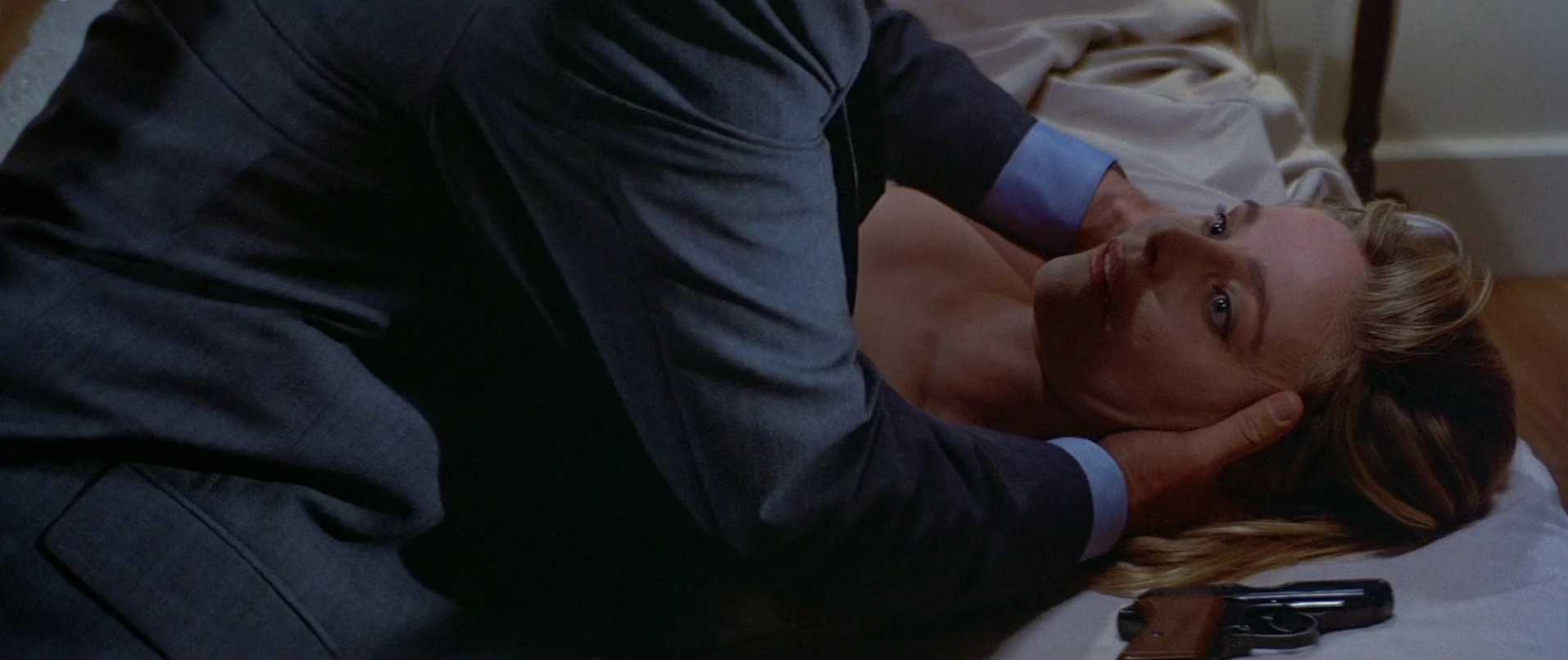
The death of Vesper Lynd in Casino Royale (2006) fundamentally transforms Bond. Holding Lynd’s lifeless body in the flooded elevator, Bond appears utterly devastated. His famous declaration that “the bitch is dead” attempts to project emotional detachment, yet M immediately recognizes it as a defense mechanism designed to conceal overwhelming grief. Rather than disappearing after one film, Lynd’s memory becomes one of the emotional foundations of Craig’s tenure.
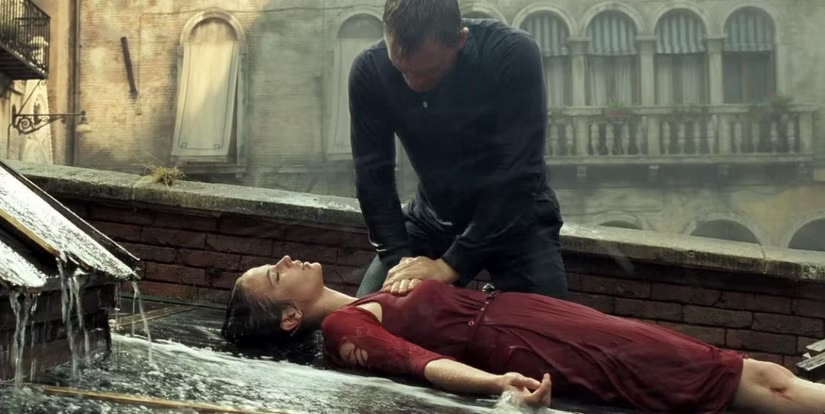
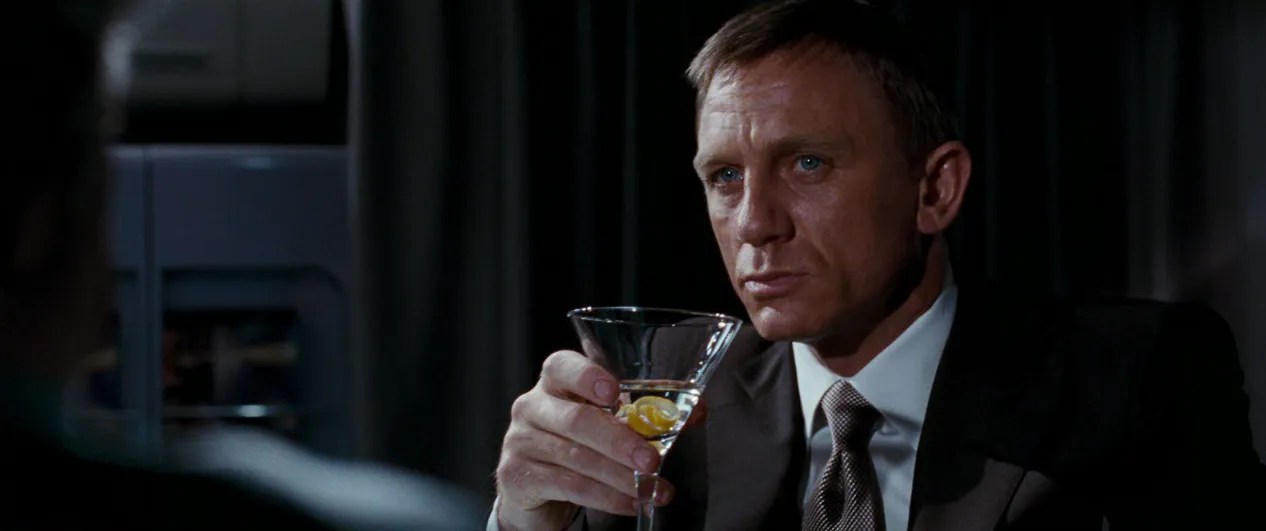
Quantum of Solace (2008) repeatedly reinforces this loss. Bond continues to carry Lynd’s necklace, her musical theme echoes throughout the film, and even the Vesper martini functions as a ritual of remembrance. Bond has not simply lost the woman he loved. He has lost his first great love, his innocence, and perhaps the possibility of leaving the Service altogether. His grief is no longer episodic. It has become serialized.
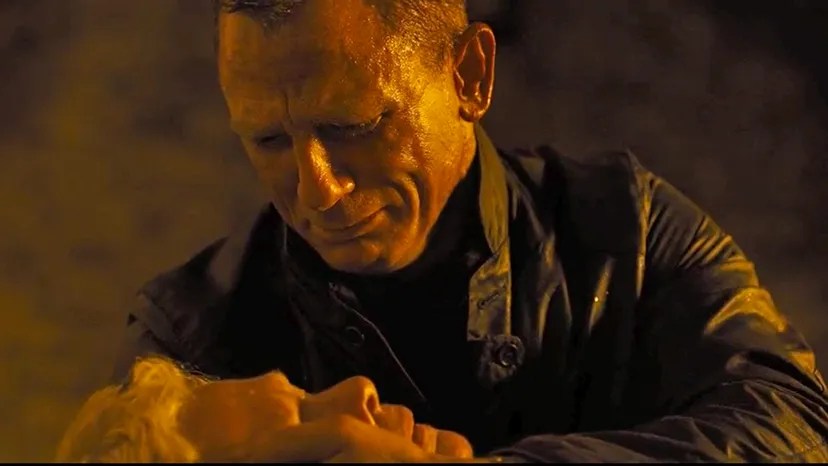
The death of M in Skyfall (2012) expands Bond’s experience of grief beyond romantic love. Their relationship extends well beyond professional obligation into something resembling family. M serves simultaneously as mentor, commander, confidante, and maternal figure. Her death leaves Bond emotionally untethered, a loss that continues into Spectre (2015) through her recorded message, her posthumous instructions, and even the small but meaningful gift of her porcelain bulldog. Once again, Bond’s grief remains active rather than resolved.
Grieving the Future
Perhaps the franchise’s most profound exploration of grief arrives not through the death of another character, but through Bond’s own.
By the conclusion of No Time to Die (2021), Bond has finally discovered something he has spent an entire career believing was impossible: a family. Madeleine Swann and Mathilde offer Bond a future beyond MI6, one defined not by missions but by love, fatherhood, and ordinary life.
Standing atop Safin’s island, Bond realizes that future has become impossible. Infected with nanobots that would kill Swann and Mathilde upon contact, he chooses to remain behind. The emotional weight of this sequence lies not simply in Bond’s impending death but in what he understands he will never experience. He will never watch Mathilde grow up. He will never build a life with Swann. He will never inhabit the ordinary future he has finally allowed himself to imagine.
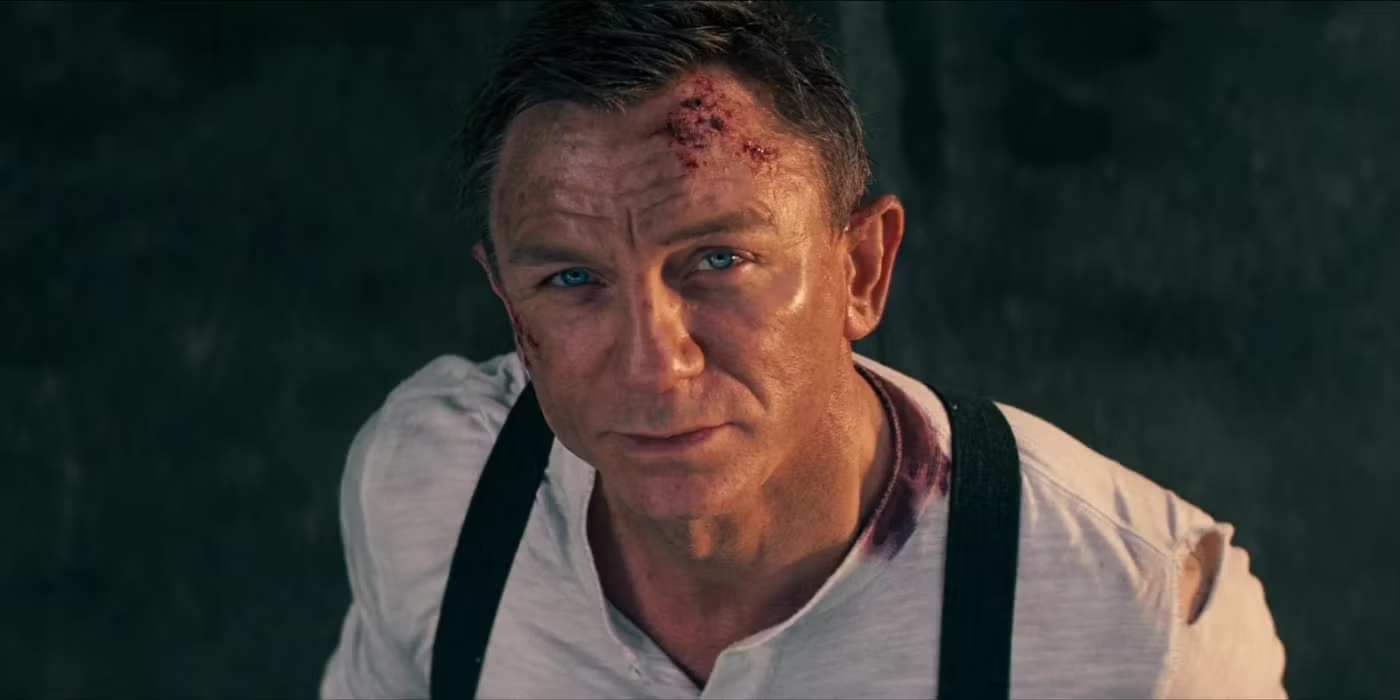
Throughout the franchise, Bond repeatedly grieves the people he has lost. In No Time to Die, however, he grieves something even more devastating: the future he will never have.
Licence to Grieve
James Bond’s enduring appeal has often been attributed to his confidence, resilience, and ability to survive impossible situations. Yet one of his most compelling qualities is not his emotional detachment but his extraordinary capacity to remember. He visits graves, carries keepsakes, returns to unfinished conversations, and quietly honours the people who have shaped his life. His grief does not weaken him. Instead, it deepens his humanity.
More importantly, Bond’s grief provides one of the few consistent emotional threads across an otherwise episodic franchise. While villains change, gadgets evolve, actors are recast, and political contexts shift, the franchise repeatedly returns to its defining losses. Through memory, ritual, and remembrance, James Bond remains emotionally connected to the people—and the futures—he has lost.
James Bond may possess a licence to kill, but across more than sixty years of storytelling, he has also been granted something far more human: a licence to grieve. It is this long memory, carried quietly from one mission to the next, that ultimately makes him one of cinema’s most enduring and emotionally resonant heroes.
Why the world’s most famous spy continues to shape how we imagine espionage.
People often ask me why I continue studying James Bond.
It is a fair question. Ian Fleming introduced the character in Casino Royale in 1953, yet more than seventy years later Bond continues to provoke debate. He has been praised as an enduring cultural icon, criticized as a relic of another era, and repeatedly declared irrelevant. Every few years, someone predicts that the franchise has reached the end of its life.
My response is usually another question: Why do we keep watching him?
Or perhaps the better question is this: Why do we keep recreating him?
James Bond has become far more than a successful fictional character. He has become one of the defining cultural reference points for the modern spy genre. Whether audiences celebrate Bond, critique him, parody him, or reject him altogether, they continue to return to him. More importantly, they continue to reinvent him. That persistence suggests we are witnessing something larger than the longevity of a popular franchise. We are witnessing the evolution of a cultural language.
Reinvention Has Always Been Bond’s Greatest Strength
The decision to kill James Bond in No Time to Die appeared, at first, to place the future of the franchise in genuine jeopardy. For the first time in the franchise’s history, Bond did not simply escape another impossible mission. He died.

Yet the response was telling. Almost immediately, the conversation shifted from whether Bond should return to who would become the next Bond. The character’s death did not end the franchise; instead, it renewed public interest in its future.
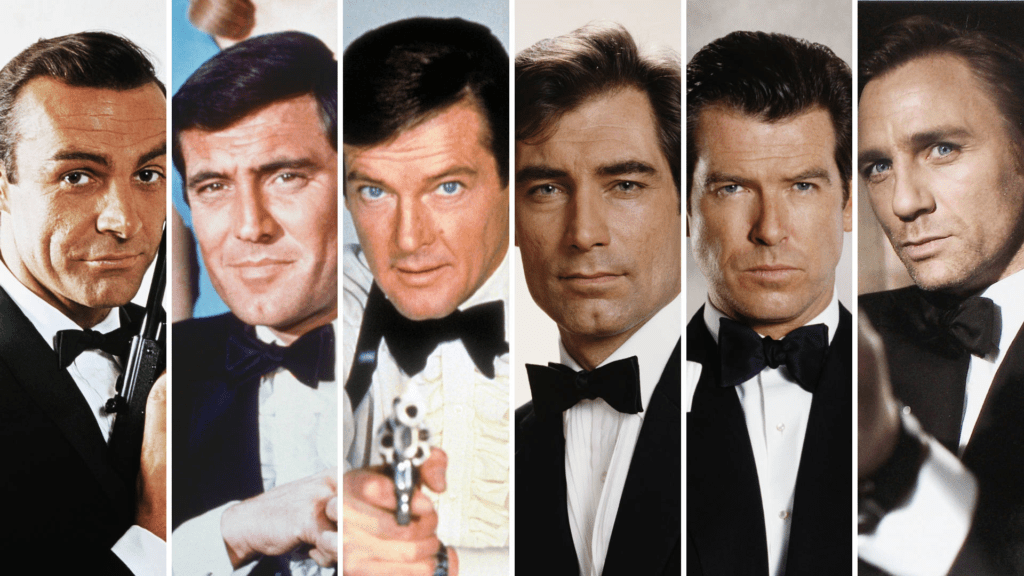
Bond has always been defined by reinvention. His first transformation occurred when Fleming’s literary spy became a cinematic hero through Sean Connery. Every subsequent actor inherited more than the role of James Bond; they inherited the responsibility of convincing audiences that Bond still belonged in the world they inhabited. Roger Moore reflected the escapism of the 1970s. Timothy Dalton returned to Fleming’s harder edge. Pierce Brosnan repositioned Bond after the Cold War, while Daniel Craig reconstructed him for a post-9/11 world marked by uncertainty, vulnerability, and emotional complexity.
Each era has grappled with the same underlying question: Does the world still need James Bond?
We are watching that question unfold once again. Amazon MGM Studios has assumed creative control of the franchise, Denis Villeneuve has been announced as director, and casting director Nina Gold has begun the search for the next Bond. No actor has yet been chosen, yet speculation has become a global conversation. Names such as Jacob Elordi, Callum Turner, and Harris Dickinson dominate headlines, fan forums, and social media.
That level of anticipation is remarkable. Few fictional characters generate worldwide debate before a story has even been written. The fascination is not simply about casting an actor. It is about deciding what James Bond should represent for a new generation.
Bond Has Outlived the World That Created Him
Few fictional characters survive the disappearance of the institutions and historical circumstances that produced them. James Bond emerged from postwar Britain. He was shaped by the anxieties of the Cold War, Britain’s changing place in the world, and Ian Fleming’s imagination. Over the decades, he has survived the collapse of the Soviet Union, the end of the Cold War, globalization, terrorism, the digital revolution, and profound shifts in attitudes toward gender, power, and national identity.
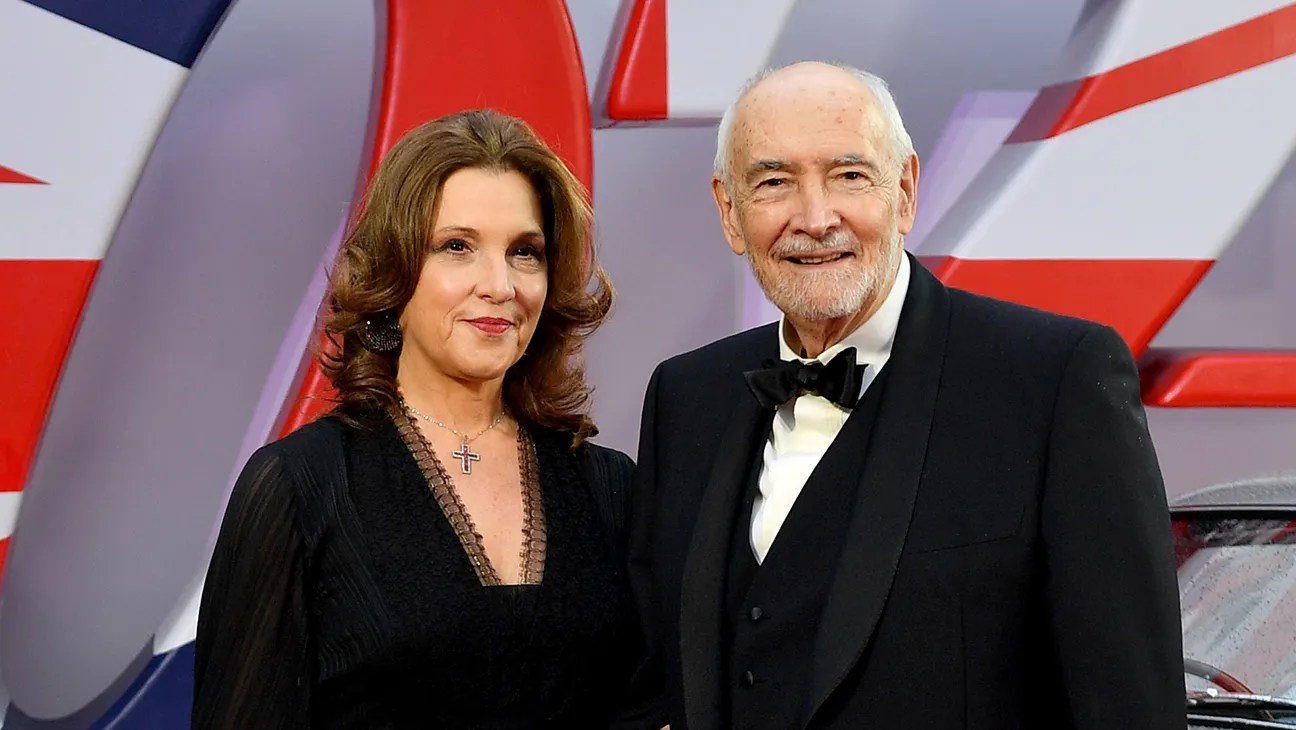
The franchise itself has evolved as well. Bond has outlived Fleming, adapted to six actors, and now enters a new era beyond the Broccoli family’s six decades of creative stewardship. The institutions that first defined Bond have changed dramatically, yet the character continues to evolve because culture itself continues to evolve.
Longevity alone, however, does not explain Bond’s significance.
James Bond as a Cultural Language
This is why I believe James Bond matters in 2026. Bond is no longer simply a fictional spy or even a successful film franchise. He has become a cultural language. Like any language, it is learned, shared, adapted, and spoken by others.
Languages are more than words. They are systems of shared meaning with recognizable vocabularies, structures, and conventions. We know when someone is speaking French or Japanese because we recognize familiar patterns of sound, rhythm, and grammar. James Bond functions in much the same way.
We immediately recognize Bond’s visual language through the tailored tuxedo, the Aston Martin, the gun barrel sequence, glamorous international locations, luxury brands, and meticulously choreographed action. We hear Bond’s audio language in Monty Norman’s iconic theme, the sweeping title songs, and the unmistakable cadence of “Bond. James Bond.” We understand Bond’s narrative language through familiar conventions: the pre-title sequence, the mission briefing, the gadgets, beautiful and glamorous women, the charismatic villain, the loyal ally, the globe-spanning investigation, and the spectacular final confrontation.
These conventions have become so deeply embedded in popular culture that they no longer belong exclusively to James Bond. They have become the vocabulary through which modern espionage stories are told.
More importantly, they have become a language that audiences speak fluently. We instantly recognize when a film, television series, video game, or advertisement is “doing Bond,” even when the character himself is nowhere to be found. That level of cultural recognition extends beyond influence. It reflects a shared understanding of a storytelling grammar that has become embedded within the spy genre itself.
Speaking Bond
Like any language, Bond can be spoken with different accents.
Some spy franchises embrace Bond’s elegance, glamour, spectacle, and globe-trotting adventures. Others deliberately reject those qualities in favour of realism, moral ambiguity, or psychological complexity. Still others parody Bond’s conventions while simultaneously celebrating them. Yet all of these approaches acknowledge Bond’s centrality.
Jason Bourne derives much of its identity by rejecting Bond’s sophistication and reliance on gadgets. Kingsman amplifies Bond’s style into gleeful excess, while Spy playfully satirizes the genre by exposing and subverting many of its familiar conventions. Mission: Impossible increasingly embraces the globe-spanning spectacle, elaborate action sequences, and impossible set pieces long associated with Bond. Other series, from Jack Ryan to Citadel and Slow Horses, similarly position themselves within a genre whose conventions Bond helped establish.

Whether they imitate Bond, parody Bond, or deliberately distance themselves from Bond, they are all speaking the same cultural language.
Beyond the Spy Genre
James Bond’s influence extends well beyond espionage. His impact can be seen in fashion, music, advertising, luxury branding, tourism, technology, and video games. Bond has become shorthand for a particular way of imagining sophistication, heroism, adventure, and global power. Even people who have never seen a Bond film recognize the imagery, sounds, and conventions associated with the franchise.

This is what distinguishes cultural influence from cultural language. Bond is no longer confined to his own stories. He has become part of the broader vocabulary through which popular culture imagines espionage.
Has Bond Become Canon?
As someone who has spent much of my career studying James Bond, I have often found myself thinking about another enduring cultural figure: Shakespeare. At first glance, the comparison may seem surprising. Shakespeare and Bond belong to different historical periods, different media, and different cultural traditions. Yet what interests me is not the comparison between the works themselves, but what happens when a creative work transcends its original form.
Shakespeare’s influence extends well beyond the plays themselves. His characters, stories, and language have become part of our shared cultural vocabulary. People recognize Romeo and Juliet, Hamlet, or the phrase “To be or not to be” without necessarily having read Shakespeare. His influence can be found across literature, theatre, film, television, and everyday speech.
I wonder whether James Bond is undergoing a similar transformation.
People recognize the tuxedo, the martini, the Aston Martin, and the phrase “Bond. James Bond.” They understand Bond references in films, television, advertising, video games, and countless parodies without having seen every Bond film—or even any Bond film. Bond has become part of our cultural literacy.
That raises an interesting question. At what point does a popular cultural figure move beyond entertainment and become part of the cultural canon? Canonization is not determined solely by critical acclaim; it is also shaped by enduring influence. By that measure, Bond has already left an extraordinary mark on global culture, inspiring generations of storytellers while becoming the defining reference point for one of cinema’s most enduring genres.
Perhaps the more interesting question is not whether Bond deserves a place in the cultural canon. Perhaps it is whether he has already entered it.
Why Bond Still Matters
People still ask me why I continue studying James Bond.The answer has never really been about one fictional spy.
I study Bond because Bond reveals how culture evolves. He reflects changing ideas about heroism, technology, politics, gender, power, identity, and the stories societies choose to tell about themselves. More importantly, he demonstrates how cultural icons survive—not by remaining unchanged, but by continually adapting to new audiences, new technologies, and new historical moments.
The question in 2026 is not simply who will become the next James Bond. It is why, more than seventy years after Ian Fleming first introduced 007, we are still speaking his language—a language so deeply embedded in popular culture that we already know its grammar long before we know who will speak it next. That may be Bond’s greatest achievement. He no longer belongs solely to Ian Fleming or to the franchise itself. He has become part of our shared cultural vocabulary.
For more than two decades, my scholarship has explored the women of the James Bond franchise—not as accessories to 007, but as complex figures who illuminate changing ideas about gender, heroism, race, sexuality, authority, and power. My forthcoming book, The Bond Girl Phenomenon: From Spectacle to Subject (SUNY Press), traces the remarkable evolution of Bond women across more than 60 years of cinema, arguing that they are central to understanding the cultural legacy of one of the world’s most enduring film franchises.
Rather than ranking the “best” Bond Girls, this list highlights 10 women whose characters fundamentally transformed the Bond universe. Each represents a milestone in the evolution of female representation, revealing how the Bond Girl has progressed from spectacle to subject.
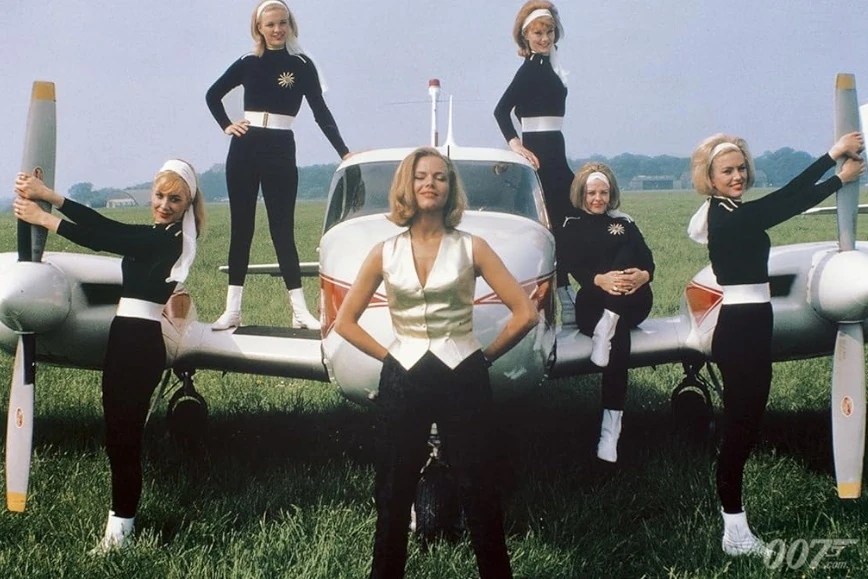
1. Pussy Galore (Goldfinger, 1964)
Pussy Galore established one of the franchise’s earliest models of the English Partner. As the leader of an all-female aviation team, she possesses professional authority, strategic intelligence, and skills that rival James Bond’s own. Her character challenged assumptions about women’s roles in early spy films and laid the foundation for future Bond women whose competence extends well beyond romance.
2. Fiona Volpe (Thunderball, 1965)
Fiona Volpe is the prototype for the modern Bond female villain. Intelligent, fearless, and unapologetically loyal to SPECTRE, she rejects redemption and remains one of Bond’s most formidable adversaries. Her confidence, sexuality, and professionalism demonstrate that female power within the franchise can exist independently of Bond’s influence.

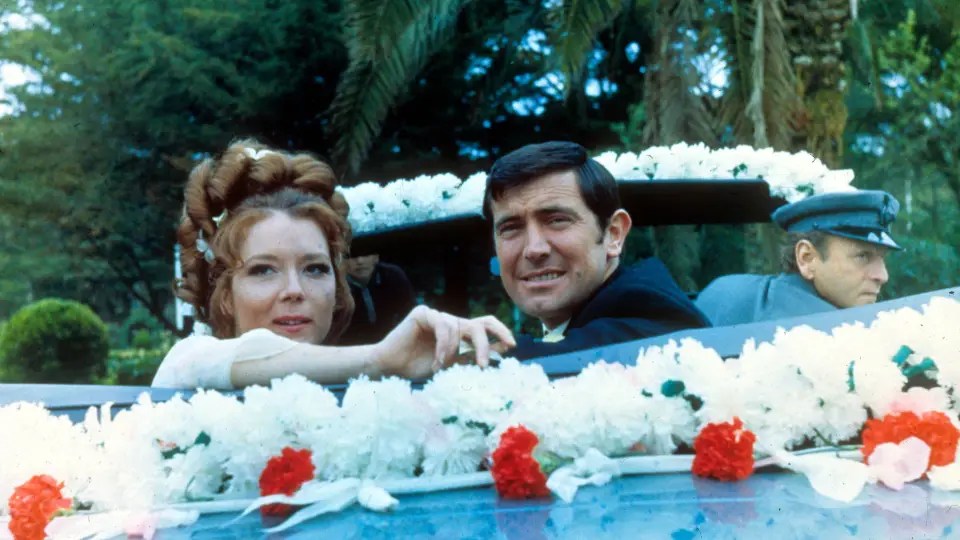
3. Tracy di Vicenzo (On Her Majesty’s Secret Service, 1969)
Tracy di Vicenzo is far more than James Bond’s wife. She is his heroic equal and emotional partner, whose courage and compassion permanently reshape his life. Her tragic death reverberates throughout the franchise, making her one of its most influential and enduring characters.
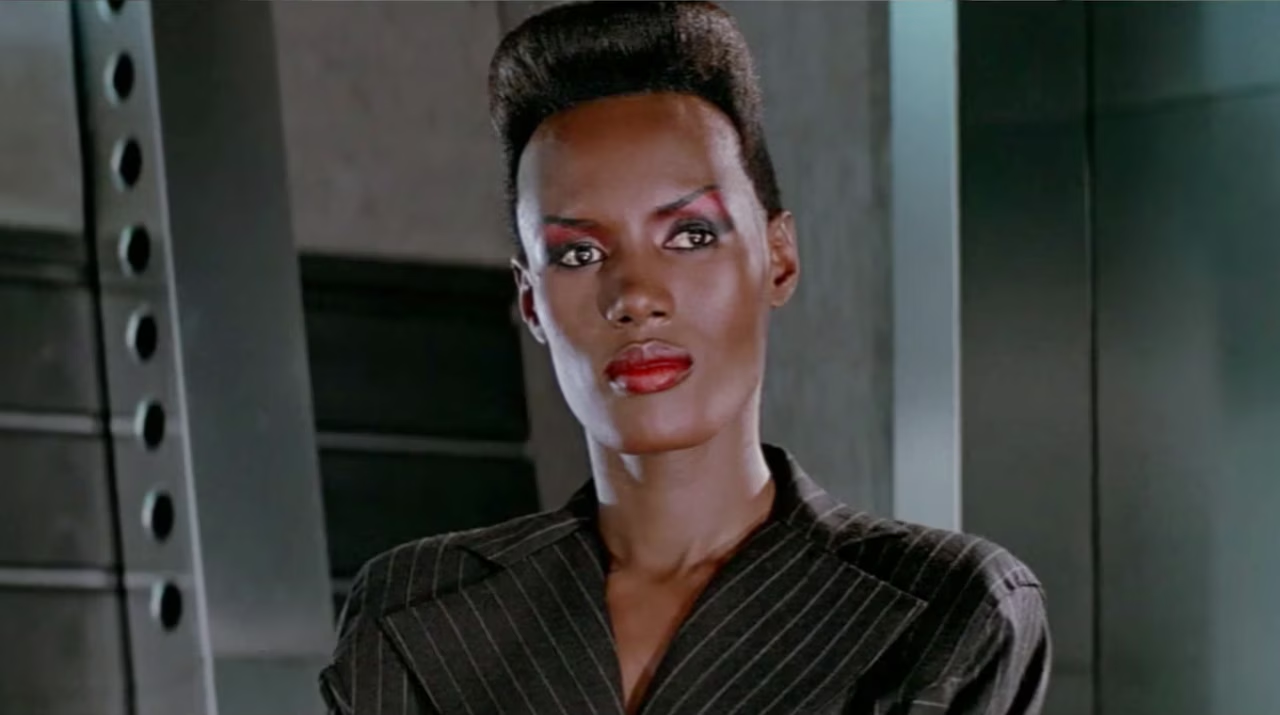
4. May Day (A View to a Kill, 1985)
May Day challenged conventional ideas of femininity through her extraordinary physical strength, athleticism, and moral complexity. Initially introduced as a ruthless villain, she ultimately sacrifices herself to save innocent lives, transforming into one of the franchise’s most compelling redeemed antagonists. Her character remains a landmark in discussions of race, gender, and power within Bond cinema.
5. Pam Bouvier (Licence to Kill, 1989)
A skilled pilot and intelligence operative, Pam Bouvier helped redefine the Bond Girl as a modern action heroine. Rather than standing on the sidelines, she actively participates in the mission, demonstrating that bravery, competence, and partnership are just as important as glamour.

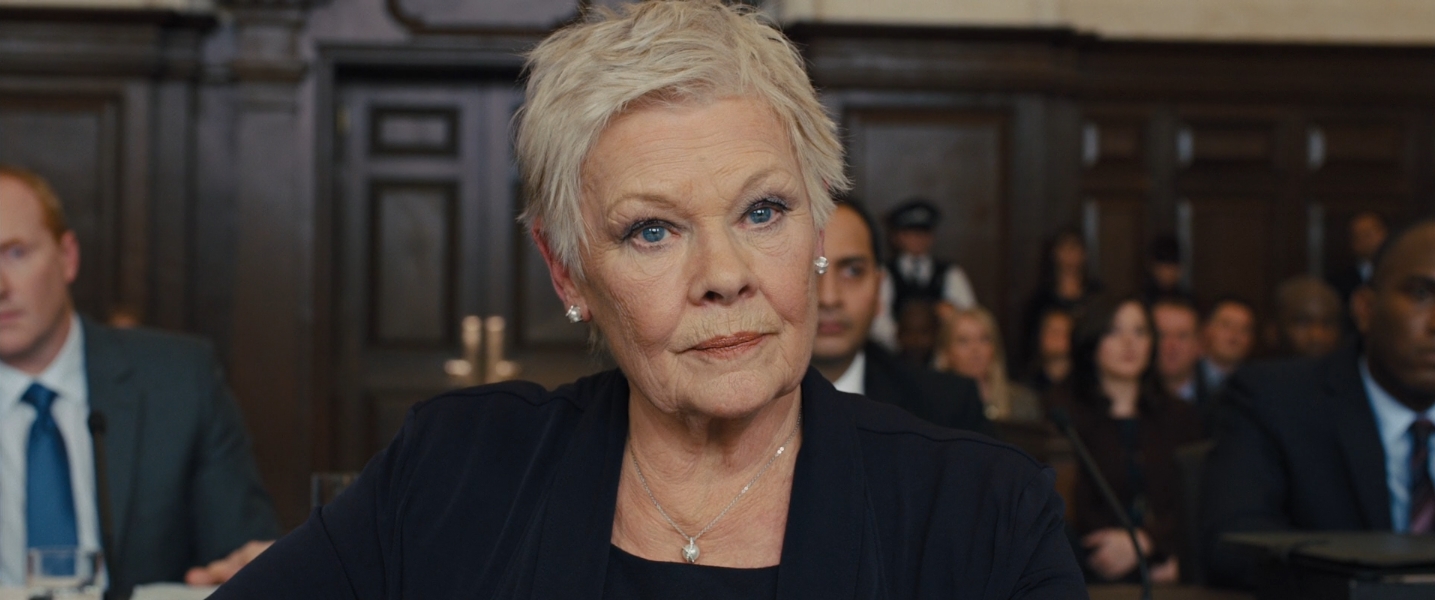
6. M (Judi Dench) (GoldenEye, 1995)
Judi Dench revolutionized the Bond franchise by becoming the first woman to lead MI6. As Bond’s superior, she challenges his methods, questions his relevance, and redefines institutional authority within the series. Her portrayal transformed one of the franchise’s most important leadership roles while reshaping the relationship between Bond and the organization he serves.
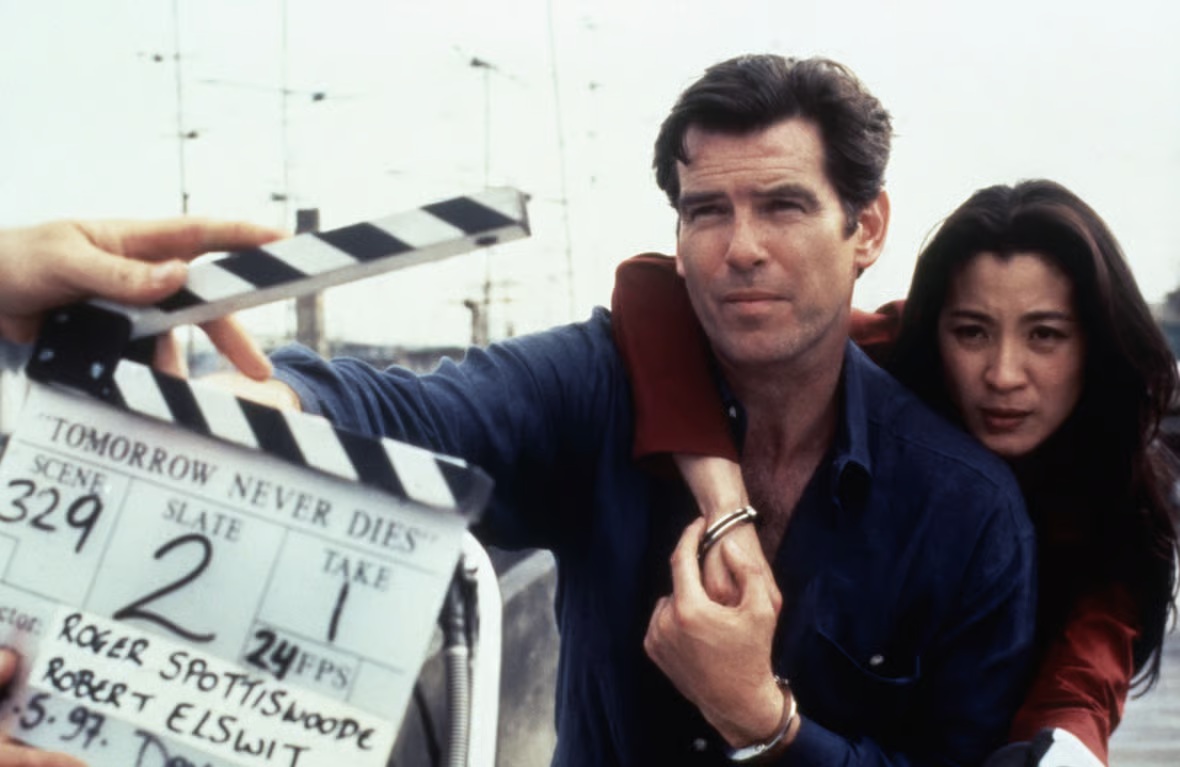
7. Wai Lin (Tomorrow Never Dies, 1997)
Wai Lin stands among the franchise’s greatest action heroes. As a Chinese intelligence agent, she consistently matches—and often surpasses—Bond in combat, strategy, and resourcefulness. Her character expanded representations of Asian women while demonstrating that the Bond Girl could be an international action hero in her own right.

8. Elektra King (The World Is Not Enough, 1999)
Elektra King is the franchise’s first female arch villain. Introduced as a vulnerable kidnapping survivor, she is ultimately revealed to be the mastermind behind the film’s central conspiracy. By positioning a Bond woman as the principal antagonist rather than a henchwoman or secondary villain, The World Is Not Enough fundamentally reimagines female power within the franchise. Her intelligence, manipulation, and strategic control make her one of the most psychologically complex and influential women in Bond history.

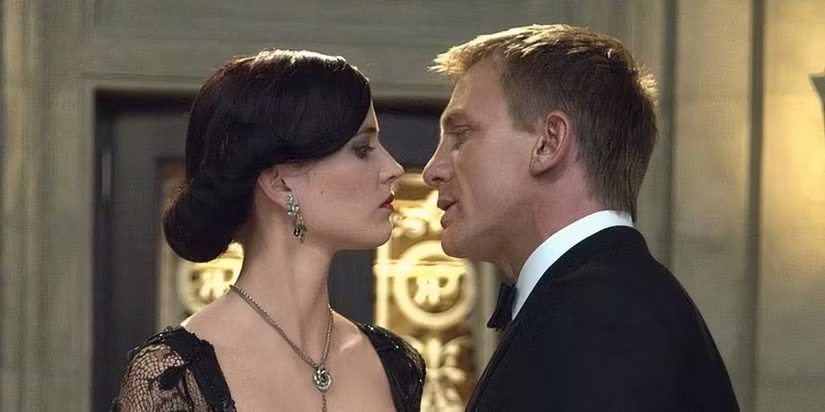
9. Vesper Lynd (Casino Royale, 2006)
Vesper Lynd transformed both James Bond and the Bond Girl. More than a romantic interest, she occupies the overlapping roles of heroine, victim, and antagonist, becoming central to Bond’s emotional evolution. Her complexity marks a turning point in the franchise and exemplifies the Bond–Bond Girl Hybrid explored throughout my book.
10. Nomi (No Time to Die, 2021)
Nomi represents the latest stage in the Bond Girl’s evolution. As the first woman to hold the 007 designation, she inherits one of popular culture’s most recognizable symbols while prompting new conversations about gender, race, and institutional change. Her character demonstrates that the future of the Bond franchise continues to be shaped by its women.

Why These Women Matter
These ten women represent only a fraction of the remarkable characters examined in The Bond Girl Phenomenon: From Spectacle to Subject. Collectively, they illustrate how Bond women have continually challenged expectations, expanded the boundaries of heroism, and reshaped one of cinema’s most iconic franchises. From Pussy Galore’s professional authority to Nomi’s inheritance of the 007 designation, their stories reveal that the Bond Girl has never been a static figure. Instead, she has continually evolved alongside changing cultural understandings of gender, power, identity, and leadership.
As I argue throughout The Bond Girl Phenomenon, understanding James Bond ultimately requires understanding the women who have defined, challenged, and transformed his world. They are not merely part of the story—they are central to it.
As the final film of the Daniel Craig era, No Time To Die (2021) is deeply referential to Bond tradition. Yet one of its most surprising achievements lies in its treatment of the Bond Girl. Drawing on both the literary and cinematic versions of The Spy Who Loved Me, the film shifts attention away from James Bond and toward the women whose stories have traditionally existed at the margins of the franchise.
The film opens not with Bond, but with a young Madeleine Swann witnessing the murder of her mother by Lyutsifer Safin. This traumatic encounter establishes a deeply personal connection between the Bond Girl and the villain before Bond even enters the story. Unlike most Bond films especially in the Daniel Craig era, where the conflict revolves around Bond himself, No Time To Die positions Swann at the emotional center of the narrative.

This approach has roots in Ian Fleming’s 1962 novel The Spy Who Loved Me, which is famously told from the perspective of Vivienne Michel rather than Bond. Fleming devotes considerable attention to Michel’s childhood, relationships, and unintended pregnancy before Bond appears. Similarly, Swann is given a life, history, and motivations that exist independently of Bond.
The centrality of Swann becomes even clearer on a second viewing. Initially, her secrecy invites suspicion from both Bond and the audience. Once viewers learn she is pregnant (like Michel) and attempting to protect her unborn child, however, her actions take on a very different meaning. Rather than appearing deceptive, she emerges as a sympathetic figure manhandled and subsequently abandoned by Bond in a moment of anger and mistrust.

The film briefly returns to a more familiar Bond Girl archetype through Paloma. Dressed in an elegant evening gown reminiscent of Bond Girl Anya Amasova from The Spy Who Loved Me (1977), Paloma initially presents herself as inexperienced and somewhat nervous about her first field assignment. Her performance draws on a longstanding Bond tradition in which femininity functions as a form of disguise, encouraging both Bond and the audience to underestimate her capabilities.
The façade quickly disappears during the film’s standout Cuba sequence, where Paloma reveals extraordinary combat and gunplay skills. Combining glamour, humour, and physical competence, she fights alongside Bond as an equal partner in the mission. In doing so, Paloma recalls the Action Hero Bond Girls of the 1990s and early 2000s, women who actively participated in the action rather than merely supporting Bond from the sidelines.

Ultimately, however, the film belongs to Swann. The story revolves around her reunion with Bond, the revelation of their daughter Mathilde, and Bond’s efforts to protect the family he never expected to have. His final sacrifice is motivated not by Queen and country, but by the women he loves.
Most significantly, No Time To Die begins and ends with Swann’s perspective. It opens with her childhood trauma and concludes with her telling Mathilde a story about Bond. By framing the narrative through Swann’s memories and storytelling, the film transforms Bond from the sole hero of the story into someone remembered through the eyes of a Bond Girl.

In the end, No Time To Die asks audiences to reconsider whose story is being told. While James Bond remains the franchise’s iconic hero, it is Madeleine Swann who shapes the narrative, preserves his legacy, and tells the story of “the spy who loved us.”
Since its inception, the James Bond franchise — across both James Bond novels and films — has consistently emphasized the Anglo-American alliance through the enduring partnership and friendship between James Bond and Felix Leiter. Their relationship functions as a symbolic fusion of British intelligence expertise and American material power. Bond brings precision, strategy, and experience; Leiter represents the vast institutional and military resources of the United States.
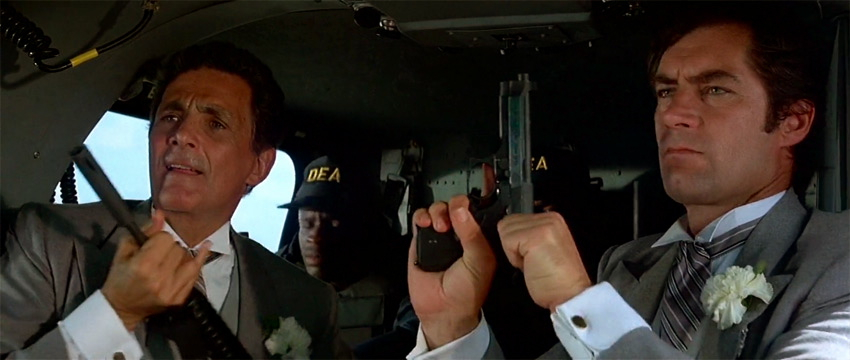
This dynamic has been repeatedly staged on screen. In films such as Thunderball (1965) and The Spy Who Loved Me (1977), Bond may lead the mission, but the success of that mission is often underwritten by American support — ships, submarines, and intelligence networks. The “special relationship” is not simply referenced, it is dramatized.
While the report itself may be speculative — even playful — it nevertheless raises a compelling question about how the Bond franchise might respond to shifting geopolitical realities in Bond 26. For decades, Leiter has been framed as Bond’s “brother from the CIA,” most explicitly articulated in Casino Royale (2006). Yet that framing now feels increasingly unstable. Under President Donald Trump, fractures in the United States’ relationships with NATO allies and the United Kingdom have complicated the very alliance Leiter has historically embodied. In narrative terms, one might even ask whether that symbolic relationship effectively ended with Leiter’s death in No Time to Die.
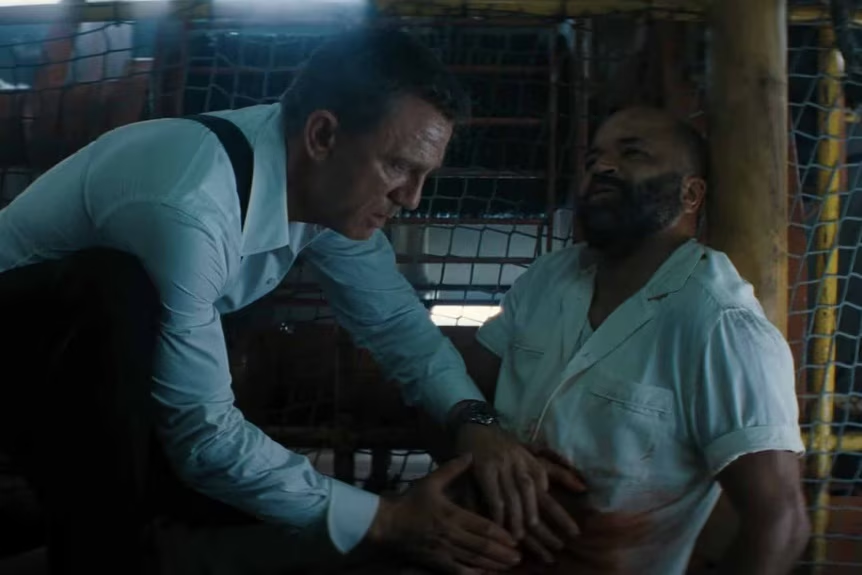
Reimagining Leiter as Canadian offers a compelling alternative — one that reflects changing global dynamics. Under Prime Minister Mark Carney, Canada has positioned itself as both a stabilizing force within NATO, ally to the UK, and an increasingly assertive geopolitical actor. No longer merely aligned with dominant powers, Canada is actively shaping its role within global alliances while strengthening its economic and resource influence.
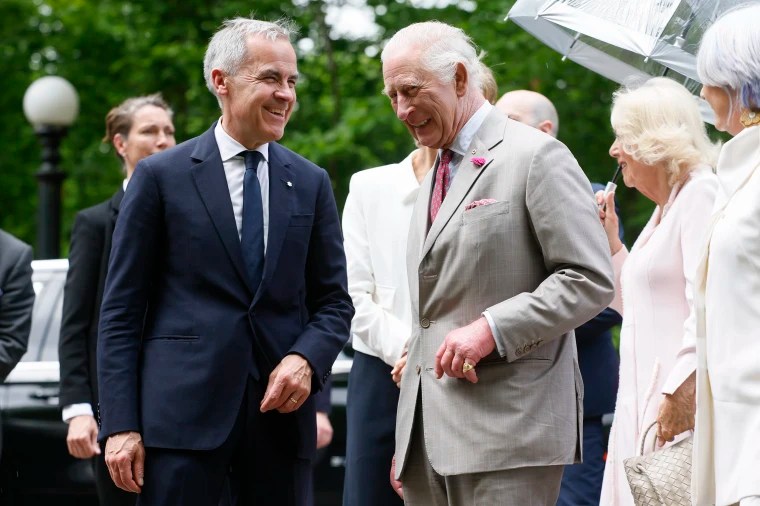
In this context, a Canadian Felix Leiter would represent more than a national shift — it would signal a reorientation of the Bond franchise’s geopolitical imagination. Rather than reinforcing a binary Anglo-American axis, the series could move toward a more complex, multipolar network of alliances in which influence is distributed rather than centralized.
Even if the report itself proves unfounded, the idea is telling. It reflects a growing recognition that the world Bond inhabits — and the alliances that structure it — are no longer what they once were.
And perhaps that is the real story: not whether Felix Leiter becomes Canadian, but why that possibility now feels plausible.
By Dr. Lisa Funnell

For decades, disability activism has existed at the margins of broader social justice movements. Even within institutions, accessibility is frequently siloed — treated as an add-on rather than a core pillar of equity, diversity, and inclusion (EDI) initiatives. This separation has shaped not only our social and political landscapes, but also our cultural ones. Nowhere is this more visible than in popular film.
Blockbuster cinema plays a powerful role in shaping how we understand identity, power, and “normalcy.” And while many viewers dismiss franchises like James Bond as “just entertainment,” the messages embedded within them especially around disability are far from harmless. In fact, they frequently reinforce ableist tropes that have circulated for over a century.
One of the most persistent of these tropes is the use of facial scarring and other visible differences to signify villainy. As the Craig era Bond films (2006-21) demonstrate, this practice is not only alive and well, but accelerating at a moment when disability advocates are calling loudly for change.
Why Disability Representation in Film Falls Short
When disability appears on screen, it is almost always shaped—and played—by people without disabilities. As scholar Elisa Shaholli notes, this gives nondisabled creators the power to define the role; while disability may be visible in the frame it is erased from the production process.
This absence of lived experience contributes to harmful patterns:
- Disabilities presented as symbols rather than realities
- Characters defined by their impairments rather than their identities
- Facial differences coded as evidence of moral corruption
These tropes are not new. As early as the silent film era, villains were marked by scars, burns, alopecia, albinism, and other dermatologic features meant to evoke unease and “otherness.” As Paul Longmore argues, such depictions position disabled characters as less human and, at times, literally monstrous.
These old ideas continue to shape contemporary storytelling. And franchises with global reach, like James Bond, carry particular weight in reinforcing them.
Bond’s History of Villainizing Facial Difference
The Bond franchise has always relied on physical contrast to build its hero. Bond’s masculinity is elevated by juxtaposing his “ideal” body against that of adversaries who are framed as freakish, excessive, or impaired.

Before the 1990s, facial scarring was rare in Bond films. Blofeld’s scar in You Only Live Twice (1967) is the standout example. But with the Brosnan era—and even more so with the Craig era—facial difference becomes a core shorthand for villainy.
Across the Craig films, this trope is used repeatedly:


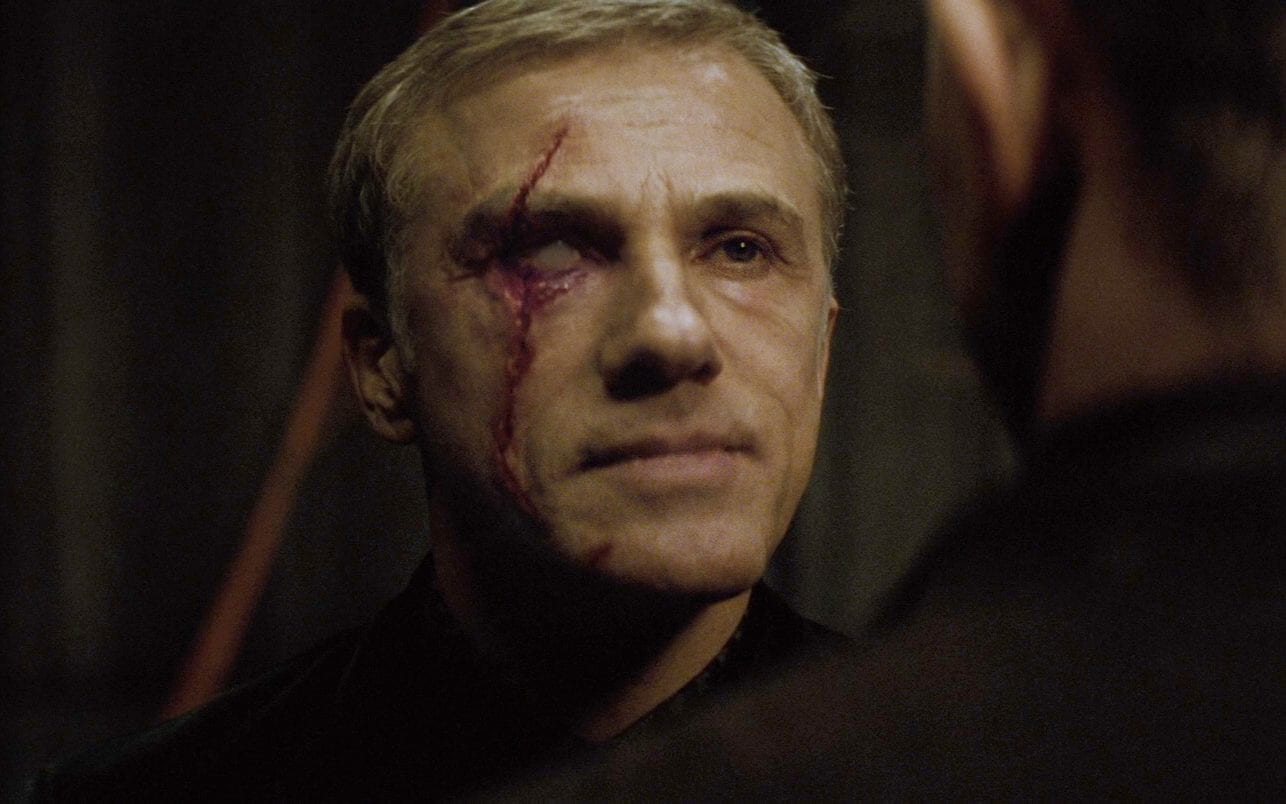


This is not incidental. These creative choices signal a deeper problem: Ableism has become embedded in the visual language of the Bond brand.
When Tradition Becomes a Problem
Some defenders of the franchise argue that scars are simply an homage to Bond history. Others claim that visible differences efficiently communicate a backstory in a film with limited time.
But these justifications ignore three critical realities:
1. Audiences are harmed by this shorthand.
Campaigns like #IAmNotYourVillain—supported by UK charity Changing Faces—document how cinematic scar tropes fuel real-world discrimination.
2. Industry leaders have already acknowledged the problem.
In 2018, the British Film Institute (BFI) committed to no longer funding films that use facial difference as visual shorthand for villainy.
3. Bond has continued anyway.
Despite global conversations about disability representation, No Time To Die (2021) features three villains with facial scarring—its highest count yet.
At that point, it is no longer coincidence. It is a pattern.
Why This Matters for Bond’s Future
The Craig era is often celebrated for its “progress” including the casting of Black actors as Felix Leiter and Moneypenny, or the brief re-assignment of the 007 number to Lashana Lynch.
But representation gains in gender and race cannot be used to offset ableist practices. A franchise cannot be progressive only when easy and where convenient.
What’s more, these creative decisions reflect the values of the core team shaping Bond storytelling for over two decades—producers Barbara Broccoli and Michael G. Wilson, long-time screenwriters Neal Purvis and Robert Wade, and directors including Sam Mendes.
The Bond Franchise Has a Choice to Make
As Bond enters another transition—with a new lead and a new creative vision—the question is not simply who the next 007 will be. The deeper question is:
Will the franchise continue relying on outdated, ableist narrative devices?
Or will it evolve alongside the audiences who have been calling for change?
Bond has survived for over 60 years because it adapts to shifting cultural landscapes. But progression requires more than casting choices or gender-politics updates. It requires rethinking how stories are told and who gets harmed in the storytelling process.
The old Bond is dead. It’s time for the old representational practices to die with him.
If the next era of Bond wants to remain relevant, compelling, and socially conscious, then the franchise must finally retire the trope of scarring-as-villainy and embrace a world where disability representation is neither monstrous nor metaphorical, but fully human.

Co-written with Klaus Dodds
Water is a critical resource to the sustainment of human, plant, and animal life. While water is plentiful on earth, only 3 percent of it is freshwater and more than half is inaccessible as it is frozen in glaciers. Moreover, freshwater is not equally distributed on earth and six countries account for more than half of the world’s fresh water supply: Brazil, Russia, Canada, Indonesia, China, and Columbia (Krapivin and Varotsos, 2008, p.495).
Water Wars and Bond Villainy in Quantum of Solace
Although water is a renewable resource, the world’s supply of fresh water is steadily decreasing due to contamination and overuse (via industrialization and agriculture), and nearly a billion people worldwide lack access to safe drinking water. As a result, water has increasingly become a source of conflict as nations, regions, and groups fight to control water resources. And it is the conflict over water, and not oil, that is at the heart of Quantum of Solace.
Bolivia is not only the setting for the film but it also provides the best historical example of the fight over water privatization. In 1999, the World Bank recommended the privatization of the municipal water supply in Cochabamba and El Alto/La Paz, Bolivia’s two largest cities. As noted by Jim Shultz “the World Bank argued that handing water over to foreign corporations was essential in order to open the door to needed investment and skilled management” (2008, p.126). In Cochabamba, this led to a four-year contract with an American consortium, Bechtel Corporation of California, who doubled the price of water upon taking it over, leaving many poor families with the choice between buying water or food. This increase led to citywide protests and eventually the government revoked its water privatization legislation, after first attempting to protect the agreement by instituting martial law (McPhail and Walters, 2009, p.171). A similar uprising in 2005 led to the Bolivian government’s cancellation of a water privatization deal in El Alto/La Paz with the Suez Corporation of France (Shultz, 2008, p.126).
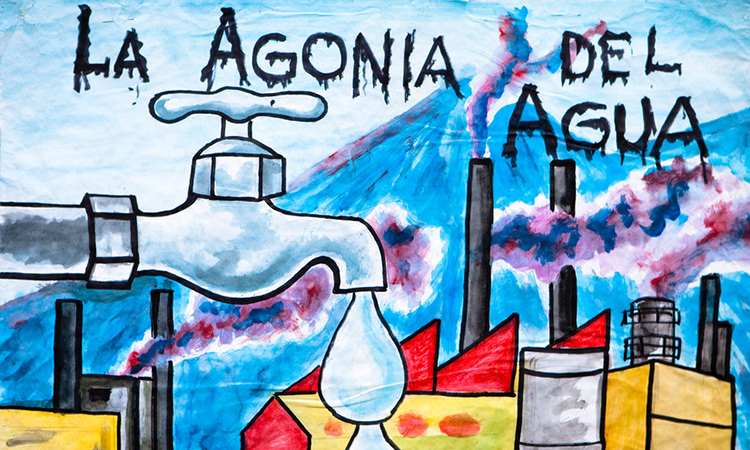
Water privatization in Bolivia is the central objective for the villain, Dominic Greene, in Quantum of Solace. Greene masquerades as an environmentalist and philanthropist who espouses water and environmental conservation. He is the founder of Greene Planet, an environmental corporation that buys up large portions of land for ecological preservation. During a fundraiser in Bolivia, he describes his Tierra Project as “one small part of a global network of eco-parks that Greene Planet has created to rejuvenate the world on the verge of collapse.” This project, however, is really a Quantum initiative designed to covertly establish water privatization in Bolivia.

When Greene describes the processes by which deforestation in Bolivia has led to desertification and an increase in the price of water, he is referring to the actions that he has set in motion through his multinational corporations. What he does not mention is the way in which he collected and stored the freshwater underground by erecting dams that have stopped the resource from flowing to the rest of the country. Through the vilification of Greene and his corporation, the film strongly criticizes water privatization and the foreign acquisition of domestic freshwater reserves (while appearing more ambivalent on oil rights). Moreover, the film positions Quantum, an international terrorist organization, in the role of the World Bank and condemns their capital programs in developing nations like Bolivia. Importantly, it is Bond as an agent of Britain who restores geopolitical order and returns oversight of local resources back to the Bolivian government.
Bond, Water, and Gender in the 007 Franchise
In Quantum of Solace, water conflict takes on gendered connotations. Water has long played a critical role in the Bond films. Bond is frequently immersed in water: he fights in and under water, travels on and under water, and sometimes has to prevent water from overwhelming places (e.g. A View to a Kill). He understands the role that water pressure can play on the immersed body (e.g. For Your Eyes Only) and is adept at adjusting his behavior to take constraints and opportunities offered by water such as impromptu water-skiing (e.g. License to Kill).
Although Bond frequently operates in water, the element has historically been associated with women due to the reproductive capacity of the female body and its link to the ‘waters of life;’ in various art and written texts, the female body is described as a vessel/container and women have largely been essentialized in relation to their wombs in both society and culture. This association is forwarded in the Bond films in many of the opening credit sequences, which feature women underwater moving around (and seducing) men. According to Eileen Rositzka, these women “conjure up images of the nymphs from Greek or Latin mythology—beautiful maidens filling nature with life. A nymph is also regarded as a siren who lures a man—to his death” (2015, p.153). As such, these anonymous women are presented as being threatening to Bond as they distract him from his mission.

The Bond Girls in the film proper are also strongly associated with water and depicted as water nymphs and sirens. This connection was established in the inaugural Dr. No, which features Honey Ryder emerging from the sea while singing (Piotrowska, 2015, p.171). The combination her image and voice are so appealing that they attract the male gaze of Bond and his helper Quarrel who stop and stare thereby haling narrative progress in order to look at her. Moreover, it is Ryder’s knowledge of the island and its waterways that facilitates their escape from capture. Ryder is the first in a series of Bond Girls that Bond first sees (e.g. Jinx Johnson), meets (e.g. Domino Derval), kisses (e.g. Wai Lin), and works with (e.g. Melina Havelock) underwater in the series. The film enrolls patriarchal sentiments by associating women with the feminine element of water and Bond’s subsequent use and mastery over them (both separately and combined).
Water in the Daniel Craig Era
As revisionist films, the orphan origin trilogy recalibrates many elements characteristic of the series including the association of water with women. In Casino Royale, it is Bond and not his lover Vesper Lynd who is envisaged through Bond Girl iconography. On two occasions, Bond emerges from the sea in a bathing suit and his body is positioned as the object of the gaze for two female onlookers: Solange watches Bond swim along the coastline while Lynd waits for him to exit the ocean on the beach (Funnell, 2011a, p.467). Through the intertextual referencing of Honey Ryder, Bond is depicted through the well-known iconography of the Bond Girl: he is positioned as the object of the gaze and associated with water.
This connection is carried into the climax of the film in which Bond is unable to save a drowning Lynd from a building that has collapsed into the Venice canal; by locking herself in the elevator carriage, Lynd commits suicide by drowning and it is Bond who lives and carries on. This effectively works to dissociate women with water while masculinizing the element. This relationship is carried over into the next film, Quantum of Solace, as the first three Craig era films are more serial in nature and constitute a trilogy (with Spectre possibly being the starting point of a ‘Blofeld trilogy’) that conveys the orphan origin story of Bond, which is concluded in Skyfall.

In Quantum of Solace, Bond’s association with water is both literal and symbolic. On the one hand, Bond uses his instincts and skill set to discover the man-made aquifer underground and deduce Greene’s master plan. After Bond explains the situation to Camille Montes, shots of the pair walking through the mine shaft and then through the desert are intercut with images of the local villagers congregating around a small water tower that is empty and discussing the situation. Interestingly, the majority of villagers are men even though in most developing countries where water is collected outside the home it is women and girls who carry out the task. The foregrounding of men in this scene emphasizes the threat of water shortage on the community (rather than individual households) and in most patriarchal societies it is men who engage in social dialogue about local issues.
However, the scene does not contain subtitles and most audiences will not be able to discern the concerns relayed through this exchange. As a result, these voices are rendered less important like background noise—a symbolic representation of their limited power and lack of involvement in water privatization—as they cannot be accessed and understood. And it is Montes, a rogue Bolivian agent, who stands in and speaks out for the Bolivian people (and not the Bolivian government).
The relationship that develops between Bond and Montes can be read in both geopolitical and elemental terms. On the one hand, Bond as an agent of Britain intervenes in the Bolivian water conflict through his collaboration with Montes, and their growing friendship stands in for the strengthening of British and Bolivian relations. Although the government of Bolivia is in flux, Bond supports the people who are represented by Montes in the film.
On the other hand, Bond and Montes are associated with the antithetic elements of water and fire respectively (see above), and their collaboration is necessary to relieving the drought in Bolivia. After Montes kills Medrano in the climax of the film, the eco hotel becomes engulfed in fire and she requires rescue from Bond who makes his way through the inferno untouched by the flames and carries her to safety. As a result, Bond is metaphorically associated with “the waters of life” as he saves Montes from the fiery danger inflicted by Medrano and Bolivia from the water collection and privatization of Greene.
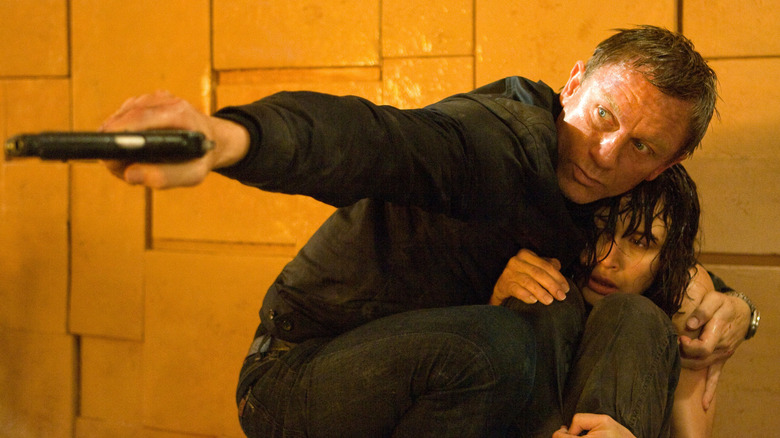
Bond’s association with water continues into the denouement when he travels to Russia to confront Lynd’s former lover, Yusef Kabira, a Quantum operative who seduces women working in intelligence agencies in order to gain access to government information. After Bond interrogates the man, he leaves the apartment complex and indicates to M that he has received closure as he throws Lynd’s necklace to the ground. The film relies on pathetic fallacy to externalize the emotions of the stoic Bond through the falling snow.

On the one hand, the snow—water in liquid form—signals that Bond’s thirst for vengeance has been quenched as he has found the man responsible for the manipulation of Lynd. The scene can be read as Bond finally letting go of his anger and this closure takes the form of snow falling around him. On the other hand, the snow represents the freezing or hardening of Bond’s heart, a necessary step to ensuring his physical and emotional safety as a secret agent. In literal and symbolic ways, Bond resolves the conflict associated with water in both the geopolitical and personal realm.

As a character, James Bond is not only defined by his actions (i.e. what he does), but also by his social privilege (i.e. who he is) as relayed through his encounters with other characters and especially women. The heroic identity of Bond is rooted in the British lover literary tradition (Hawkins 29-30) which relies on the ‘lover’ stereotype of masculinity and is conveyed through virility. As a result, seducing and sexually satisfying (heroic and villainous) women is built into the world of Bond and this heteronormative performativity is framed as a tipping point that ensures mission success (Black 107). Since the inaugural Dr. No (Young 1962), the cinematic world of Bond has strongly relied on a network of women to shape the heroic image and iconic identity of Bond.
While the women featured in the Bond series range in terms of their role (from primary characters to secondary figures), affiliation (heroic and villainous), and social locations (such as race, sexual orientation, and age), they are often grouped together under the umbrella term ‘Bond Girl.’ This academic and popular moniker not only obscures the diversity of female representation but also reduces the narrative importance of women by presenting them as functions of Bond (i.e. they are Bond’s girl).

Moreover, the use of the term ‘girl’ to describe women infantilizes them and diminishes their professional accomplishments while stressing their sexual availability to Bond (with womanhood being reserved in the series for marriage and motherhood). By comparison, the men featured in Bond films are given standalone identities (i.e. they are not Bond’s men) and are never insulted/infantilized through their referencing as ‘Bond Boys.’ While it is difficult to avoid using the term ‘Bond Girl’ due to its cultural pervasiveness, it is important to be attentive to the messages being relayed through it about gender, power, and identity in series (Funnell, “Reworking” 12).
Bond interacts with a variety of women in each film. The first major category consists of female protagonists who are envisaged through the Bond Girl archetype. Here the term Bond Girl is reserved for one woman in each film who is the primary hero and is romantically involved with Bond in the end (Funnell, “From” 63). She is frequently depicted as an object of desire via ‘the male gaze’ (see Mulvey 1988) as Bond and the villain compete for her affections.
The Bond Girl has gone through various phases including English Partner (1962-1969), American Sidekick (1971-1989), and Action Hero (1995-2002), with the archetype being deconstructed and reintroduced across the Craig Era (2006-2015; see Funnell, ‘Reworking’ 2018). While Bond Girls vary in terms of their narrative importance, autonomy in decision making, heroic competency, and core abilities (in such areas of fighting, driving, and intelligence gathering, among others), their social locations remain relatively consistent. For instance, a white woman has been featured as the lead protagonist in twenty-one of twenty-four (88%) Bond films. This draws attention to the centrality of whiteness in the casting for this coveted role across five decades.

The second major category consists of villainous women who often work as henchpeople for the arch-villain. Much like the Bond Girl, female villains shift through various phases of representation with their frequency of appearance, narrative importance, autonomy, and competency fluctuating in response to changing waves of feminism: second wave (1960s), antifeminist backlash (1970s), third wave (1980s), and postfeminist (1990s onwards) movements (see Funnell ‘Negotiating’ 2011).
Female villains frequently challenge the heteropatriarchy and especially their presumed/prescribed position both sexually and socially below Bond. They are killed off in their films in order to resolve the threat to Bond’s libidinal masculinity and restore phallocentric order. While there is greater racial diversity amongst female villains than Bond Girls, the series relies on problematic stereotypes when representing women of color. Travis Wagner notes that black women in particular have been presented in deeply troubling ways through hypersexualization and treated as disposable objects of pleasure in the series (see Wagner 2015).

The third category consists of recurring female characters within MI6 who engage with Bond largely in professional contexts. Miss/Eve Moneypenny is the most recurring female figure in the series and works as the personal assistant to Bond’s boss, M. She has long served as a trusted friend and ally to Bond, and her flirtatious exchanges with Bond never progress romantically outside of the office. Lois Maxwell pioneered the role but was replaced after A View to a Kill (Glen 1985) when she was deemed too old to play the part.
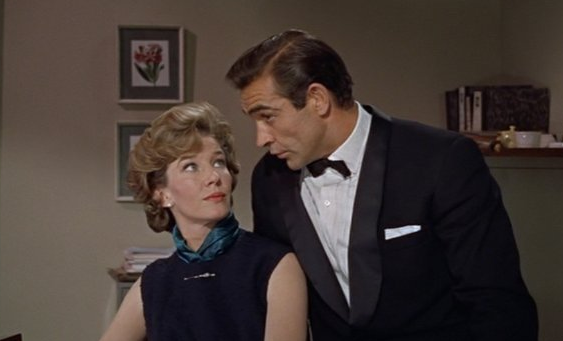
By comparison, Desmond Llewelyn, who was first featured in From Russia with Love (Young 1963) was able to continue playing the role of Q until his death in 1999. Their differing career trajectories draw attention the intersection of gender and age in the series (Dodds 215); the series relies strongly on the aesthetic ideal of femininity (which is largely white, slim, and young) in the depiction of female characters and relays the impression that women working with/under Bond are to serve as objects of desire for him and the (presumed male target) viewer by extension.

In Skyfall (Mendes 2012), Moneypenny was given an origin story and introduced as a field agent who was subsequently demoted to a desk job after accidentally shooting Bond in the field. Unlike Bond, Moneypenny has yet to be given a redemption narrative after making one mistake in the field and this double standard can be attributed, at least in part, to her being a black woman (played by Naomie Harris) in the Craig era films (see Kristin Shaw 2015).
Age, professional experience, and race also play a role in shaping the identity of Judi Dench who plays Bond’s boss M across the Brosnan (1995-2002) and Craig era films (2006-2015). While Dench’s M is clearly distinguished from her male predecessors via gender, the films also stress her lack of military/field experience and imply that she rose through the ranks via civil service. She is referred to as a ‘bean counter’ and the ‘evil queen of numbers’ by her agents and staff who open question her authority (see Patton 2015, Holliday 2015). The early films also mention that she is married with children.
While Dench’s M is shown to navigate the sexual politics of military and government agencies, she remains privileged by her race and her confrontation of sexism does not explicitly address the racism within the organization. This is most evident in Skyfall when she sides with and supports Bond, who is not physically fit to return to the field, over Moneypenny who followed her order to take the unclean shot at Bond; Bond is supported by M while Moneypenny is disciplined and demoted.As the series progresses, the films increasingly stress the maternal nature of Dench’s M (who is now widowed and estranged from her biological children) and by the end of Skyfall she requires the protection of Bond who is positioned as her (only family and) surrogate son.

Bond also interacts with a series of secondary women across his films who range in terms of their role, screen time, autonomy, and heroic competency as well as whether or not they are (important enough to be) named. Charles Burnetts likens these women to ‘fluffers’ in the porn industry who keep the male star aroused until his primary interest arrives at which time they disappear off-screen (60).
Moreover, the opening credits feature the (semi-)nude bodies of women cast in shadow/silhouette dancing/moving in a variety of scenarios. According to Sabine Planka, ‘sex sells’ and the Bond franchise serves up the bodies of these nameless women who are not featured in the film proper as appetizers to stimulate the viewer’s appetite (141). These images are paired with title tracks that are predominantly performed by women or male singers with a ‘feminine quality’ to their voice (Piotrowska 167). Their melodies are often woven into the soundtrack and help to shape (and arguably provide balance to) the (masculine) world of Bond. While there is greater diversity amongst the musical performers (i.e. the disembodied voices) who are heard and not seen, the anonymous and often silent women featured on screen are more consistent in terms of their race (i.e. white), physique (i.e. slim), and age (i.e. young).
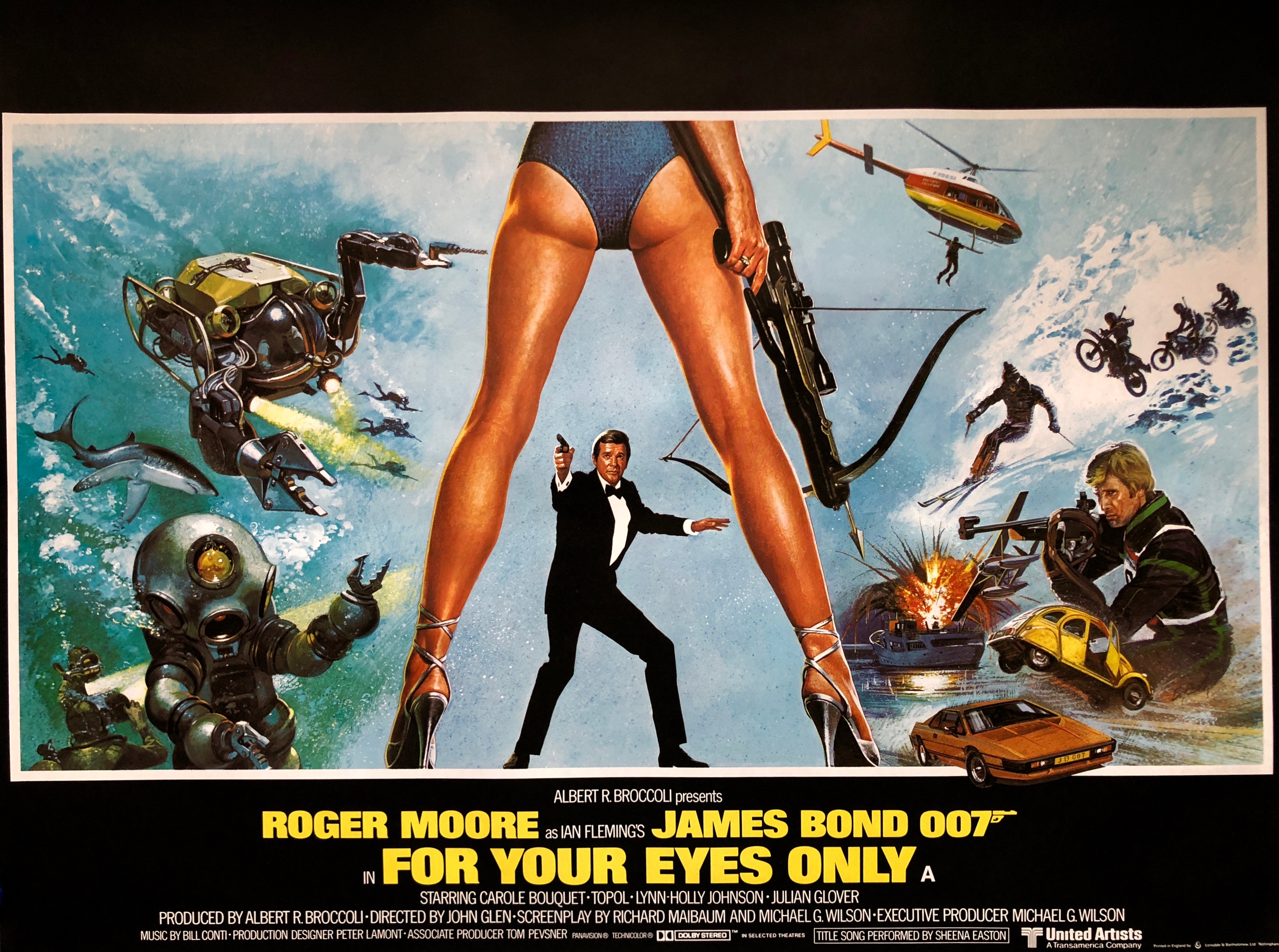
The Bond franchise has also historically relied on women in their extra-textual materials and marketing strategies. For instance, in the first four decades of the franchise, scantily clad women are featured on Bond movie posters in sexually suggestive poses as well as touching or looking at Bond in a longing way. These posters simultaneously convey and confirm the heroic masculinity of Bond who is presented as gentleman (via tuxedo) hero (via holding his gun) who is also desired by a bevy of beautiful women (i.e. the lover).
Playboy magazine was also frequently used to promote the franchise and since 1965 has (un)covered many of the Bond films with special issues like “007 Oriental Eyefuls” for You Only Live Twice (Gilbert 1967), “Vegas Comes Up 007” for Diamonds Are Forever (Hamilton 1971) and “Women of 007” published in conjunction with The Living Daylights (Glen 1987). These photo spreads not only help to confirm the male gaze and emphasize the pleasures of looking at the women of Bond (see Hines 2018), but they also offer the consumer a glimpse of what Bond gets to see behind closed doors as the film themselves do not feature nudity. The franchise has expanded beyond Playboy and utilizes other men’s magazines in its marketing of Bond women in various stages of undress.
Overall, the Bond franchise has historically relied on women and especially the aesthetic ideal of femininity to both shape and promote the world of Bond to a presumed male viewership.
For a detailed discussion, see my article with Tyler Johnson on “Properties of a Lady: Public Perceptions of Gender in the James Bond Franchise”
References
- Black, Jeremy. The Politics of James Bond: From Fleming’s Novels to the Big Screen. London: Praeger, 2001.
- Burnetts, Charles. “Bond’s Bit on the Side: Race, Exoticism and the Bond “Fluffer” Character.” For His Eyes Only: The Women of James Bond. Ed. Lisa Funnell. London, UK: Wallflower Press, 2015. 60-69.
- Dodds, Klaus. “‘It’s Not For Everyone’: James Bond and Miss Moneypenny in Skyfall.” For His Eyes Only: The Women of James Bond. Ed. Lisa Funnell. London, UK: Wallflower Press, 2015. 214-223.
- Funnell, Lisa. “From English Partner to American Action Hero: The Heroic identity and Transnational Appeal of the Bond Girl.” Heroes and Heroines: Embodiment, Symbolism, Narratives and Identity. Ed. Christopher Hart. Kingswinford, UK: Midrash, 2008. 61-80.
- Funnell, Lisa. “Negotiating Shifts in Feminism: The ‘Bad’ Girls of James Bond.” Women on Screen: Feminism and Femininity in Visual Culture. Ed. Melanie Waters. Basingstoke: Palgrave, 2011. 199-212.
- Funnell, Lisa. “Reworking the Bond Girl Concept in the Daniel Craig Era.” Journal of Popular Film and Television 46.1 (2018): 11-21.
- Hawkins, Harriet. Classics and Trash: Traditions and Taboos in High Literature and Popular Modern Genres. Toronto: University of Toronto Press, 1990.
- Hines, Claire. The Playboy and James Bond: 007, Ian Fleming, and Playboy Magazine. Manchester, UK: Manchester University Press, 2018.
- Holliday, Christopher. “Mothering the Bond-M Relation in Skyfall and the Bond Girl Intervention.” For His Eyes Only: The Women of James Bond. Ed. Lisa Funnell. London, UK: Wallflower Press, 2015. 265-273.
- Mulvey, Laura. “Visual Pleasure and Narrative Cinema.” Feminism and Film Theory. Ed. Constance Penley. New York: Routledge, 1988. 57-68.
- Patton, Brian. “M, 007, and the Challenge of Female Authority in the Bond Franchise.” For His Eyes Only: The Women of James Bond. Ed. Lisa Funnell. London, UK: Wallflower Press, 2015. 246-254.
- Planka, Sabine. “Female Bodies in the James Bond Title Sequences.” For His Eyes Only: The Women of James Bond. Ed. Lisa Funnell. London, UK: Wallflower Press, 2015. 139-147.
- Piotrowski, Anna G., “Female Voice and the Bond Films.” For His Eyes Only: The Women of James Bond. Ed. Lisa Funnell. London, UK: Wallflower Press, 2015. 167-175.
- Shaw, Kristin. “The Politics of Representation: Disciplining and Domesticating Miss Moneypenny in Skyfall.” For His Eyes Only: The Women of James Bond. Ed. Lisa Funnell. London, UK: Wallflower Press, 2015. 70-78.
- Wagner, Travis L. “‘The Old Ways Are Best’: The Colonization of Women of Color in Bond Films.” For His Eyes Only: The Women of James Bond. Ed. Lisa Funnell. London, UK: Wallflower Press, 2015. 51-59.

Co-written with Klaus Dodds
In The World is Not Enough, Bond states that, “Construction isn’t exactly my specialty” to which M replies “Quite the opposite, in fact.” This exchange draws attention to the fact that Bond is a destructive hero who is not only armed with a “license to kill” but also with a “license to destroy.”
Bond makes claims on a range of spaces and his ruination of physical property plays a central role in shaping his heroic identity and professional prowess. While Bond sets out to destroy the villain’s expansive lair (usually in an explosive fashion), he rarely damages cultural artifacts and national monuments. In that sense the demolition and explosive work he engages in appear measured and proportionate. Importantly, Bond is rarely shown causing harm to animals/wildlife and takes care to rescue any person who is associated with him. His explosive capacity is thus targeted and when is he not able to destroy the villain’s lair he takes out specific elements of the villain’s portfolio.
However, as the series progresses, Bond becomes increasingly destructive and his license to destroy is amplified as the films become more action oriented. The Craig era origin trilogy amplifies the damage by setting a number of action sequences in construction zones—spaces that are partially built or destroyed, depending on how you look at it.
In Casino Royale, Bond engages in a parkour-inspired chase sequence through the construction zone of a high rise building in Madagascar. While Mollaka navigates his way over and around various obstacles, Bond rams through and destroys them in the process. This scene emphasizes Bond’s positioning in the Craig era films as a ‘blunt instrument’ whose approach to fieldwork is physical and forceful rather than subtle and nuanced.
Moreover, the construction zone can be read as a metaphor for the character of Bond. Monika Gehlawat argues that the placement of Bond in construction zones “accentuates his own attempts to emerge from underdevelopment” (2009, p.133). Over the course of three films—Casino Royale, Quantum of Solace, and Skyfall—Bond learns how to be a superspy and experiences growing pains as he learns from his physical, emotional, and psychological mistakes. The aforementioned sequence is part of Bond’s first mission after attaining his license to kill. While his desire to capture Mollaka is evident, he lacks the skill set to capture him quickly and efficiently. As a consequence, he ends up killing Mollaka and violating diplomatic protocols leading to his escapades being widely publicized in the media.
As a hero, Bond is a work in progress and this is symbolized through the use of construction sites to bookend Casino Royale. The final action sequence takes place in a partially renovated building in Venice. In her detailed analysis of the “aesthetics of demolition” in Casino Royale, Gehlawat draws attention to the movement and instability of the structure itself:
Stairwells and landings crumble and drop into the floors below and, eventually, into the canal. Light fixtures, balustrades and random objects (as well as people) seem to detach from the context and slide helplessly downward […] All the while the atmosphere of the scene is dark, confused and foreboding. The scene’s liminal quality manifests not only because it occurs in a space that is neither building nor rubble, but also because of the watery world that soon consumes it. (2009, p.137)
Gehlawat argues that this scene, in combination with the aforementioned chase in Madagascar, can be read as metaphors for the broader changes taking place in the Craig era as Bond is refashioned and updated (2009, p.137).

This scene can also be read diegetically. After discovering that his lover, Vesper Lynd, has betrayed him, he tracks her down to the building and fights her captors. Although this space is relatively empty, the construction equipment presents a new danger as it is mobilized as weapons for attack rather than pursuit. Unlike Moonraker, the conflict destroys the structure of the building, which collapses into the water below. Lynd eventually drowns after she locks herself in the elevator and refuses to be rescued. This scene can also be read as a metaphor for Bond as his faith in Lynd has been shaken and his world, much like the building, has come crashing down.

This foundational instability continues into the next film, Quantum of Solace, which opens with Bond transporting Mr. White to be interrogated by M in Siena, Italy. During the examination, M’s bodyguard Mitchell, who is working as a double agent for the Quantum organization, frees Mr. White. Bond’s pursuit of Mitchell leads them to a bell tower that is under renovation. The men crash through the glass on the roof and fall onto the scaffolding where they begin to use building materials as weapons. When Bond gets caught up in a rope, he swings upside down and struggles to reach his gun in time to kill Mitchell. Not only does the construction site increase the tension of the scene (as the viewer questions if Bond has what it takes to get the job done), but it also reflects the instability of M16 as an organization, which has traitors in its midst—first Lynd and now Mitchell.
Skyfall also uses construction zones and equipment to signify the end of the Bond’s origin story. In the pre-credit sequence, Bond uses a backhoe loader to deflect bullets on the train (although he does get shot) and create an opening to enter the train car; Bond can be seen jumping from the boom of the backhoe onto the carriage just as the back of the car is being peeled away. His progress is short lived (pun intended) as he is accidentally shot by Moneypenny and falls into the river below. This sets in motion a resurrection narrative in which Bond rebuilds himself physically, emotionally, and psychologically over the course of the film.

Bond comes across another construction zone while pursuing Silva who has escaped from M16 custody. It is here that Bond discovers Silva’s plan but not before the villain blows up a wall and causes an underground train derailment. Although Bond is a few steps behind Silva, he races through the streets of London as M recites a poem by Tennyson: “We are not now that strength which in old days moved earth and heaven, that which we are, we are. One equal temper of heroic hearts, made weak by time and fate, but strong in will. To survive, to seek, to find, and not to yield.”
This sequence creates a visual and narrative contrast between Silva, a former M16 agent who deconstructs the system from the inside, with Bond, a hero who shores up the agency from the outside. And in the end, Silva cannot destroy the will of Bond or the ideals of M16 despite destroying part of the MI6 building. In the final scene of the film, Bond enters into the office of M, retrofitted to match the design of the early Bond films. Both Bond and M16 have been rebuilt as the last line of defense for Britain.
For a detailed discussion of Bond’s “license to destroy”, see our book Geographies, Genders, and Geopolitics of James Bond.
Co-written with Klaus Dodds
Bond is a global traveler and sent on missions throughout the world. Airplanes offer the most expedient form of transportation to and from these places. Bond can be seen boarding planes (The Living Daylights), traveling in flight (Goldfinger, 1964), and exiting airports (Dr No, 1962). Bond has fought henchpeople on the runway (Casino Royale, 2006) and in the air (Spectre, 2016), and has been debriefed by allies on the tarmac (Tomorrow Never Dies, 1997). He demonstrates his knowledge of aviation technology by flying various aircrafts (You Only Live Twice, 1967) and has brought wayward planes under control (Die Another Day, 2002).
While airplanes are featured in Bond films, they are not neutral technologies and are bound by social identities – particularly nationality for large airliners and gender for light and small aircrafts.
The airplane serves as a consistent reminder of the Anglo-American special relationship. When Bond flies commercially in the 1960s, his airline of choice is Pan American (or Pan Am). Bond is shown arriving in Kingston (in Dr No) and Istanbul (in From Russia with Love, 1963) courtesy of Pan Am. He is shown travelling again with them in Live and Let Die (1973) on a brand new Boeing 747 and aborts his travel plans with the airline in Licence to Kill (1989).

While Pan Am is associated with the travel plans of Bond early in the franchise, light and small aircrafts (but not helicopters as they were always flown by men with the exception of Naomi in The Spy Who Loved Me, 1977) are feminized and largely associated with female pilots. This is established in Goldfinger with the introduction of Pussy Galore and broadened in You Only Live Twice when the flying technology is explicitly feminized.
Little Nellie is the codename for the gyroplane developed by Q. Bond frequently refers to aircraft using feminine pronouns and even refers to it as “girl”. Little Nellie’s youthfulness – due to her size and newness as a technology – is being signalled through her familial relationship as a daughter with a father/creator, Q.
Language also helps to draw parallels between the gyroplane and the Bond Girl as Bond refers to both as “good girls.” This is notable through his radio transmission following his success in an aerial fight: “Little Nellie got a hot reception. Four big shots made improper advances toward her, but she defended her honour with great success. Heading home.”
The term “girl” has historically been used as a way to diminish, deprecate, and trivialize (grown, professional) women by labelling them as immature or inexperienced. As a result, the depiction of Little Nellie not only aligns her with the Bond Girl (i.e. grown women described as Bond’s girl – see previous blogs) but also emphasizes the patriarchal role that Bond plays via touch. His heroic identity is defined not only through his seduction and domestication of the Bond Girl but also through his mastery of/over feminized technology like Little Nellie.
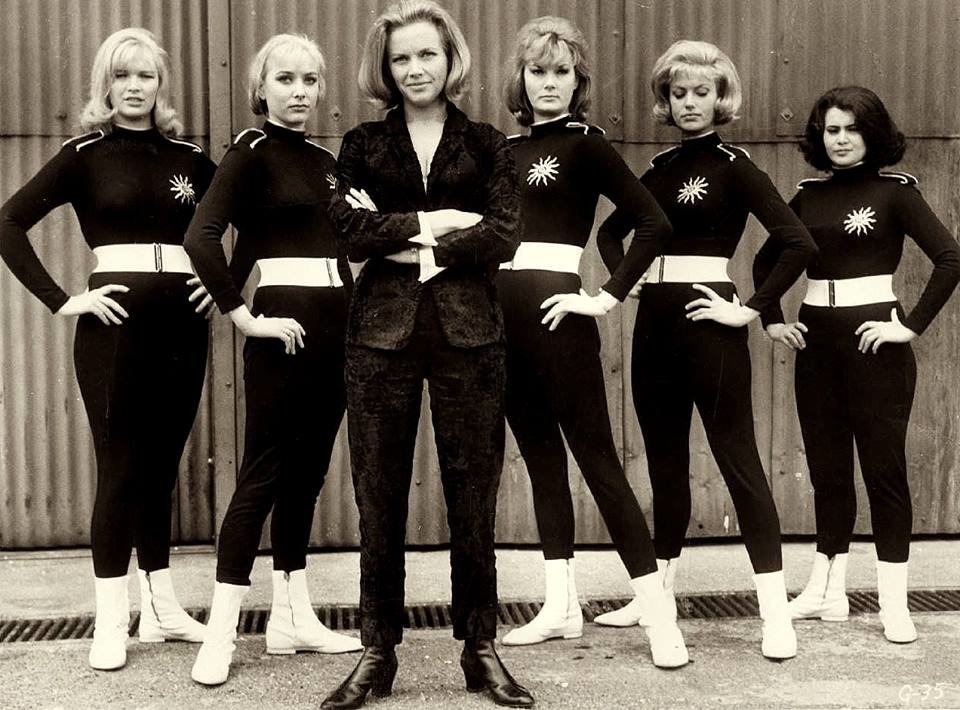
In addition to the feminization of small and light aircrafts, flying is often presented as a female profession in the Connery era and Bond’s ability to seduce a female pilot is a key factor in the success of his mission. This is most evident in Goldfinger as the villain has hired Pussy Galore to be his personal pilot. She is also a flight instructor and the head of an all-female flying troupe comprised of five beautiful women dressed in black spandex uniforms that emphasize femininity and attractiveness. These women will participate in Goldfinger’s Operation Grand Slam by crop-dusting the military surrounding Fort Knox. Thus, Bond’s ability to seduce Galore (and by extension her troupe) away from the villain proves to be the tipping point in his mission. After their sexual encounter, she exchanges gas canisters and works with the CIA to foil Goldfinger’s plan.

Extrapolating from the character of Galore, You Only Live Twice establishes the figure of the personal assistant pilot. Helga Brandt is introduced as the secretary and pilot of Mr. Osato, a Japanese industrialist who is affiliated with SPECTRE. While Brandt is a SPECTRE agent and number 11 in their hierarchy, she works in a supportive role rather than management in the office. Although Blofeld orders Brandt to kill Bond, she is seduced by him and this delays her assassination attempt. The next day, she puts a plan into play that consists of strapping Bond into a small plane and parachuting out, leaving him to die in the crash. After Bond escapes, Brandt is punished for her failure by being dropped into a pool of piranhas where she is eaten alive. As instituted by the Connery era, the seduction of the personal assistant pilot is pivotal to the survival of Bond and the success of his missions, and usually occurs at her expense – professionally and/or personally.
In the Moore and Dalton eras, female pilots are presented as either a personal assistant to the villain and/or Bond Girl pilots who work with/for Bond. For instance, in Moonraker (1979) the scantily clad Corrine who works for Hugo Drax becomes an asset to Bond soon after she gives him a flying tour of the Drax personal estate and space shuttle testing institution. After Bond seduces her, he tricks her into revealing the location of her employer’s safe. After Bond leaves, she is killed by Drax who sends his Rottweilers to chase her down in the forest. Thus the personal assistant pilot is a highly sexualized and disposable object of desire that is killed off as soon as she loses usefulness to Bond and/or the villain.

In comparison, the Bond Girl pilot plays a pivotal role in the success of Bond’s mission. In Moonraker, Dr. Holly Goodhead is introduced as an astronaut and scientist working for Drax. Although Bond initially assumes that Goodhead, like Corrine, is a personal assistant pilot he can seduce, he soon discovers that she is an undercover CIA agent and changes his approach by suggesting that they work together platonically. While Goodhead flies them into space, Bond demonstrates his intuitive understanding of aeronautics and astronautics that allows him to use the technology. And it is only after the mission has been completed that Bond finally seduces Goodhead and their zero-gravity lovemaking session is accidentally transmitted to the base back home.

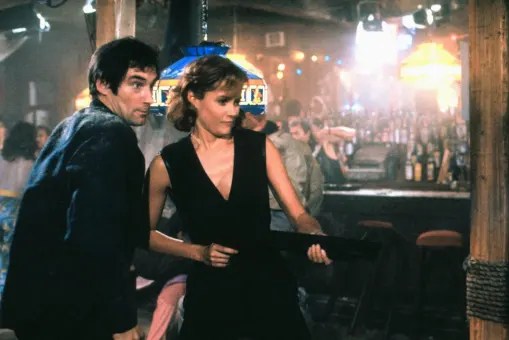
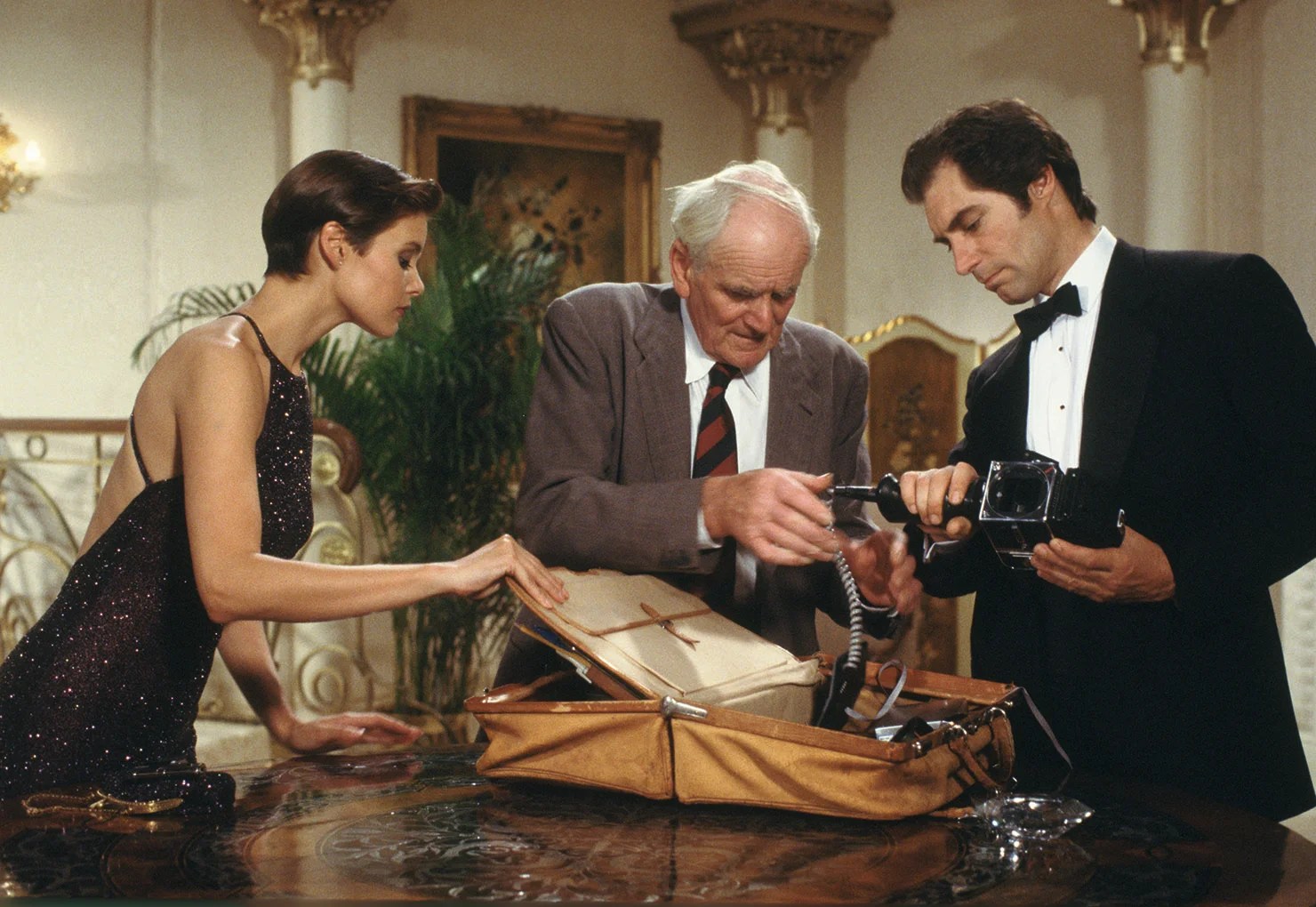
In License to Kill, Pam Bouvier is presented in a similar way as she is a pilot and CIA agent who assists Bond on his mission. She flies Bond to Isthmus City for the undercover mission and Bond introduces her as his personal assistant, a cover identity that does not go over well with her as she would rather be his boss. Bond tells her that she needs to look the part and Bouvier undergoes a makeover to increase her sex appeal; she returns with a slick haircut and formitting dresses that support her cover as a personal assistant pilot. Although Bouvier offers tactical support in the air, she operates on the periphery of the final action sequence as she flies in a crop-dusting aircraft and remains out of the conflict while Bond performs the majority of the heroic labor by confronting Sanchez in a tanker-truck chase. And like Goodhead, she consummates her relationship with Bond once the mission is complete when he chooses her over his Latin lover, Lupe Lamora.
In the Brosnan era, the female pilot is reimagined as a central antagonist through the figure of Xenia Onatopp in GoldenEye. Onatopp is initially presented as being a personal assistant pilot to General Ourmunov for whom she steals the Tiger helicopter in order to transport him to Siberia. This role is suggested through costuming, as she wears revealing clothes such as a low cut dress and a bathrobe, as well as Bond’s interest in seducing her at the casino, albeit with no success. It is later revealed that Onatopp is actually working for Alec Trevelyan and no longer functioning as a potential conquest or tipping point for Bond. This is signalled through a change in costuming as she wears a black military-styled uniform when she abseils from a helicopter to attack Bond. She is subsequently killed when Bond shoots at the aircraft, which leads to her suffocation against a tree. As the last female pilot appearing in the franchise, Onatopp highlights the dangerous role that female pilots play when they cannot be seduced or domesticated by Bond.
The intersection of nationality and gender draws attention to the geopolitical significance of the gendering of light and small aircrafts and the representation of female pilots. Importantly, only American women serve as Bond Girl pilots (Galore, Goodhead, Bouvier) while women who lack obvious national affiliation take on the secondary role of personal assistant pilot (Brandt, Naomi, Corrine). This highlights the central role that the United States has historically played in aeronautics and astronautics, and Bond’s ability to fly helicopters, light planes, fighter jets, and military transport aircrafts helps to counter-balance that aerial/aeronautic dominance. In comparison, the only female antagonist pilot (Onatopp) was once affiliated with the former Soviet Union and the theft of this technology along with Bond’s inability to seduce her, renders her as a genuine threat.
Through its representation of female pilots, the Bond franchise appears to reiterate an antiquated message that was once relayed to American and Soviet female pilots after World War II about the reestablishment of gender roles – they were expected to return to their prewar (domesticated) roles in society. Through his seduction of female pilots, Bond orients them away from the cockpit and toward the domestic sphere with his loving touch.
For a more detailed discussion of planes, trains, and automobiles in James Bond, see my book with Klaus Dodds on Geographies, Genders and Geopolitics of James Bond (2017).

