Dr. Lisa Funnell
Award-Winning Author | Media Educator & Consultant | “Dr 007” | Director of Communications, G-Woman Media

Water Conflict

Co-written with Klaus Dodds
Water is a critical resource to the sustainment of human, plant, and animal life. While water is plentiful on earth, only 3 percent of it is freshwater and more than half is inaccessible as it is frozen in glaciers. Moreover, freshwater is not equally distributed on earth and six countries account for more than half of the world’s fresh water supply: Brazil, Russia, Canada, Indonesia, China, and Columbia (Krapivin and Varotsos, 2008, p.495).
Water Wars and Bond Villainy in Quantum of Solace
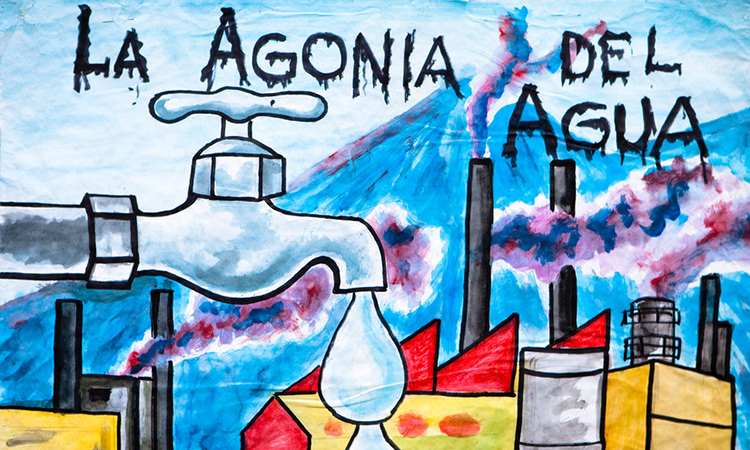
Although water is a renewable resource, the world’s supply of fresh water is steadily decreasing due to contamination and overuse (via industrialization and agriculture), and nearly a billion people worldwide lack access to safe drinking water. As a result, water has increasingly become a source of conflict as nations, regions, and groups fight to control water resources. And it is the conflict over water, and not oil, that is at the heart of Quantum of Solace.
Bolivia is not only the setting for the film but it also provides the best historical example of the fight over water privatization. In 1999, the World Bank recommended the privatization of the municipal water supply in Cochabamba and El Alto/La Paz, Bolivia’s two largest cities. As noted by Jim Shultz “the World Bank argued that handing water over to foreign corporations was essential in order to open the door to needed investment and skilled management” (2008, p.126). In Cochabamba, this led to a four-year contract with an American consortium, Bechtel Corporation of California, who doubled the price of water upon taking it over, leaving many poor families with the choice between buying water or food. This increase led to citywide protests and eventually the government revoked its water privatization legislation, after first attempting to protect the agreement by instituting martial law (McPhail and Walters, 2009, p.171). A similar uprising in 2005 led to the Bolivian government’s cancellation of a water privatization deal in El Alto/La Paz with the Suez Corporation of France (Shultz, 2008, p.126).
Water privatization in Bolivia is the central objective for the villain, Dominic Greene, in Quantum of Solace. Greene masquerades as an environmentalist and philanthropist who espouses water and environmental conservation. He is the founder of Greene Planet, an environmental corporation that buys up large portions of land for ecological preservation. During a fundraiser in Bolivia, he describes his Tierra Project as “one small part of a global network of eco-parks that Greene Planet has created to rejuvenate the world on the verge of collapse.” This project, however, is really a Quantum initiative designed to covertly establish water privatization in Bolivia.

When Greene describes the processes by which deforestation in Bolivia has led to desertification and an increase in the price of water, he is referring to the actions that he has set in motion through his multinational corporations. What he does not mention is the way in which he collected and stored the freshwater underground by erecting dams that have stopped the resource from flowing to the rest of the country. Through the vilification of Greene and his corporation, the film strongly criticizes water privatization and the foreign acquisition of domestic freshwater reserves (while appearing more ambivalent on oil rights). Moreover, the film positions Quantum, an international terrorist organization, in the role of the World Bank and condemns their capital programs in developing nations like Bolivia. Importantly, it is Bond as an agent of Britain who restores geopolitical order and returns oversight of local resources back to the Bolivian government.
Bond, Water, and Gender in the 007 Franchise
In Quantum of Solace, water conflict takes on gendered connotations. Water has long played a critical role in the Bond films. Bond is frequently immersed in water: he fights in and under water, travels on and under water, and sometimes has to prevent water from overwhelming places (e.g. A View to a Kill). He understands the role that water pressure can play on the immersed body (e.g. For Your Eyes Only) and is adept at adjusting his behavior to take constraints and opportunities offered by water such as impromptu water-skiing (e.g. License to Kill).
Although Bond frequently operates in water, the element has historically been associated with women due to the reproductive capacity of the female body and its link to the ‘waters of life;’ in various art and written texts, the female body is described as a vessel/container and women have largely been essentialized in relation to their wombs in both society and culture. This association is forwarded in the Bond films in many of the opening credit sequences, which feature women underwater moving around (and seducing) men. According to Eileen Rositzka, these women “conjure up images of the nymphs from Greek or Latin mythology—beautiful maidens filling nature with life. A nymph is also regarded as a siren who lures a man—to his death” (2015, p.153). As such, these anonymous women are presented as being threatening to Bond as they distract him from his mission.

The Bond Girls in the film proper are also strongly associated with water and depicted as water nymphs and sirens. This connection was established in the inaugural Dr. No, which features Honey Ryder emerging from the sea while singing (Piotrowska, 2015, p.171). The combination her image and voice are so appealing that they attract the male gaze of Bond and his helper Quarrel who stop and stare thereby haling narrative progress in order to look at her. Moreover, it is Ryder’s knowledge of the island and its waterways that facilitates their escape from capture. Ryder is the first in a series of Bond Girls that Bond first sees (e.g. Jinx Johnson), meets (e.g. Domino Derval), kisses (e.g. Wai Lin), and works with (e.g. Melina Havelock) underwater in the series. The film enrolls patriarchal sentiments by associating women with the feminine element of water and Bond’s subsequent use and mastery over them (both separately and combined).
Water in the Daniel Craig Era
As revisionist films, the orphan origin trilogy recalibrates many elements characteristic of the series including the association of water with women. In Casino Royale, it is Bond and not his lover Vesper Lynd who is envisaged through Bond Girl iconography. On two occasions, Bond emerges from the sea in a bathing suit and his body is positioned as the object of the gaze for two female onlookers: Solange watches Bond swim along the coastline while Lynd waits for him to exit the ocean on the beach (Funnell, 2011a, p.467). Through the intertextual referencing of Honey Ryder, Bond is depicted through the well-known iconography of the Bond Girl: he is positioned as the object of the gaze and associated with water.
This connection is carried into the climax of the film in which Bond is unable to save a drowning Lynd from a building that has collapsed into the Venice canal; by locking herself in the elevator carriage, Lynd commits suicide by drowning and it is Bond who lives and carries on. This effectively works to dissociate women with water while masculinizing the element. This relationship is carried over into the next film, Quantum of Solace, as the first three Craig era films are more serial in nature and constitute a trilogy (with Spectre possibly being the starting point of a ‘Blofeld trilogy’) that conveys the orphan origin story of Bond, which is concluded in Skyfall.

In Quantum of Solace, Bond’s association with water is both literal and symbolic. On the one hand, Bond uses his instincts and skill set to discover the man-made aquifer underground and deduce Greene’s master plan. After Bond explains the situation to Camille Montes, shots of the pair walking through the mine shaft and then through the desert are intercut with images of the local villagers congregating around a small water tower that is empty and discussing the situation. Interestingly, the majority of villagers are men even though in most developing countries where water is collected outside the home it is women and girls who carry out the task. The foregrounding of men in this scene emphasizes the threat of water shortage on the community (rather than individual households) and in most patriarchal societies it is men who engage in social dialogue about local issues.
However, the scene does not contain subtitles and most audiences will not be able to discern the concerns relayed through this exchange. As a result, these voices are rendered less important like background noise—a symbolic representation of their limited power and lack of involvement in water privatization—as they cannot be accessed and understood. And it is Montes, a rogue Bolivian agent, who stands in and speaks out for the Bolivian people (and not the Bolivian government).
The relationship that develops between Bond and Montes can be read in both geopolitical and elemental terms. On the one hand, Bond as an agent of Britain intervenes in the Bolivian water conflict through his collaboration with Montes, and their growing friendship stands in for the strengthening of British and Bolivian relations. Although the government of Bolivia is in flux, Bond supports the people who are represented by Montes in the film.
On the other hand, Bond and Montes are associated with the antithetic elements of water and fire respectively (see above), and their collaboration is necessary to relieving the drought in Bolivia. After Montes kills Medrano in the climax of the film, the eco hotel becomes engulfed in fire and she requires rescue from Bond who makes his way through the inferno untouched by the flames and carries her to safety. As a result, Bond is metaphorically associated with “the waters of life” as he saves Montes from the fiery danger inflicted by Medrano and Bolivia from the water collection and privatization of Greene.

Bond’s association with water continues into the denouement when he travels to Russia to confront Lynd’s former lover, Yusef Kabira, a Quantum operative who seduces women working in intelligence agencies in order to gain access to government information. After Bond interrogates the man, he leaves the apartment complex and indicates to M that he has received closure as he throws Lynd’s necklace to the ground. The film relies on pathetic fallacy to externalize the emotions of the stoic Bond through the falling snow.

On the one hand, the snow—water in liquid form—signals that Bond’s thirst for vengeance has been quenched as he has found the man responsible for the manipulation of Lynd. The scene can be read as Bond finally letting go of his anger and this closure takes the form of snow falling around him. On the other hand, the snow represents the freezing or hardening of Bond’s heart, a necessary step to ensuring his physical and emotional safety as a secret agent. In literal and symbolic ways, Bond resolves the conflict associated with water in both the geopolitical and personal realm.
 Dr. Lisa Funnell