Dr. Lisa Funnell
Award-Winning Author | Media Educator & Consultant | “Dr 007” | Director of Communications, G-Woman Media

The Women of James Bond

As a character, James Bond is not only defined by his actions (i.e. what he does), but also by his social privilege (i.e. who he is) as relayed through his encounters with other characters and especially women. The heroic identity of Bond is rooted in the British lover literary tradition (Hawkins 29-30) which relies on the ‘lover’ stereotype of masculinity and is conveyed through virility. As a result, seducing and sexually satisfying (heroic and villainous) women is built into the world of Bond and this heteronormative performativity is framed as a tipping point that ensures mission success (Black 107). Since the inaugural Dr. No (Young 1962), the cinematic world of Bond has strongly relied on a network of women to shape the heroic image and iconic identity of Bond.
While the women featured in the Bond series range in terms of their role (from primary characters to secondary figures), affiliation (heroic and villainous), and social locations (such as race, sexual orientation, and age), they are often grouped together under the umbrella term ‘Bond Girl.’ This academic and popular moniker not only obscures the diversity of female representation but also reduces the narrative importance of women by presenting them as functions of Bond (i.e. they are Bond’s girl).

Moreover, the use of the term ‘girl’ to describe women infantilizes them and diminishes their professional accomplishments while stressing their sexual availability to Bond (with womanhood being reserved in the series for marriage and motherhood). By comparison, the men featured in Bond films are given standalone identities (i.e. they are not Bond’s men) and are never insulted/infantilized through their referencing as ‘Bond Boys.’ While it is difficult to avoid using the term ‘Bond Girl’ due to its cultural pervasiveness, it is important to be attentive to the messages being relayed through it about gender, power, and identity in series (Funnell, “Reworking” 12).
Bond interacts with a variety of women in each film. The first major category consists of female protagonists who are envisaged through the Bond Girl archetype. Here the term Bond Girl is reserved for one woman in each film who is the primary hero and is romantically involved with Bond in the end (Funnell, “From” 63). She is frequently depicted as an object of desire via ‘the male gaze’ (see Mulvey 1988) as Bond and the villain compete for her affections.
The Bond Girl has gone through various phases including English Partner (1962-1969), American Sidekick (1971-1989), and Action Hero (1995-2002), with the archetype being deconstructed and reintroduced across the Craig Era (2006-2015; see Funnell, ‘Reworking’ 2018). While Bond Girls vary in terms of their narrative importance, autonomy in decision making, heroic competency, and core abilities (in such areas of fighting, driving, and intelligence gathering, among others), their social locations remain relatively consistent. For instance, a white woman has been featured as the lead protagonist in twenty-one of twenty-four (88%) Bond films. This draws attention to the centrality of whiteness in the casting for this coveted role across five decades.

The second major category consists of villainous women who often work as henchpeople for the arch-villain. Much like the Bond Girl, female villains shift through various phases of representation with their frequency of appearance, narrative importance, autonomy, and competency fluctuating in response to changing waves of feminism: second wave (1960s), antifeminist backlash (1970s), third wave (1980s), and postfeminist (1990s onwards) movements (see Funnell ‘Negotiating’ 2011).
Female villains frequently challenge the heteropatriarchy and especially their presumed/prescribed position both sexually and socially below Bond. They are killed off in their films in order to resolve the threat to Bond’s libidinal masculinity and restore phallocentric order. While there is greater racial diversity amongst female villains than Bond Girls, the series relies on problematic stereotypes when representing women of color. Travis Wagner notes that black women in particular have been presented in deeply troubling ways through hypersexualization and treated as disposable objects of pleasure in the series (see Wagner 2015).

The third category consists of recurring female characters within MI6 who engage with Bond largely in professional contexts. Miss/Eve Moneypenny is the most recurring female figure in the series and works as the personal assistant to Bond’s boss, M. She has long served as a trusted friend and ally to Bond, and her flirtatious exchanges with Bond never progress romantically outside of the office. Lois Maxwell pioneered the role but was replaced after A View to a Kill (Glen 1985) when she was deemed too old to play the part.
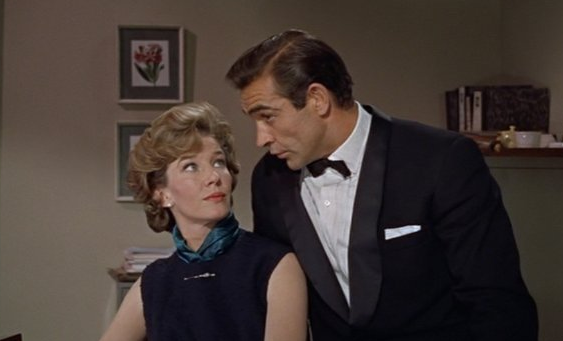
By comparison, Desmond Llewelyn, who was first featured in From Russia with Love (Young 1963) was able to continue playing the role of Q until his death in 1999. Their differing career trajectories draw attention the intersection of gender and age in the series (Dodds 215); the series relies strongly on the aesthetic ideal of femininity (which is largely white, slim, and young) in the depiction of female characters and relays the impression that women working with/under Bond are to serve as objects of desire for him and the (presumed male target) viewer by extension.

In Skyfall (Mendes 2012), Moneypenny was given an origin story and introduced as a field agent who was subsequently demoted to a desk job after accidentally shooting Bond in the field. Unlike Bond, Moneypenny has yet to be given a redemption narrative after making one mistake in the field and this double standard can be attributed, at least in part, to her being a black woman (played by Naomie Harris) in the Craig era films (see Kristin Shaw 2015).
Age, professional experience, and race also play a role in shaping the identity of Judi Dench who plays Bond’s boss M across the Brosnan (1995-2002) and Craig era films (2006-2015). While Dench’s M is clearly distinguished from her male predecessors via gender, the films also stress her lack of military/field experience and imply that she rose through the ranks via civil service. She is referred to as a ‘bean counter’ and the ‘evil queen of numbers’ by her agents and staff who open question her authority (see Patton 2015, Holliday 2015). The early films also mention that she is married with children.
While Dench’s M is shown to navigate the sexual politics of military and government agencies, she remains privileged by her race and her confrontation of sexism does not explicitly address the racism within the organization. This is most evident in Skyfall when she sides with and supports Bond, who is not physically fit to return to the field, over Moneypenny who followed her order to take the unclean shot at Bond; Bond is supported by M while Moneypenny is disciplined and demoted.As the series progresses, the films increasingly stress the maternal nature of Dench’s M (who is now widowed and estranged from her biological children) and by the end of Skyfall she requires the protection of Bond who is positioned as her (only family and) surrogate son.

Bond also interacts with a series of secondary women across his films who range in terms of their role, screen time, autonomy, and heroic competency as well as whether or not they are (important enough to be) named. Charles Burnetts likens these women to ‘fluffers’ in the porn industry who keep the male star aroused until his primary interest arrives at which time they disappear off-screen (60).
Moreover, the opening credits feature the (semi-)nude bodies of women cast in shadow/silhouette dancing/moving in a variety of scenarios. According to Sabine Planka, ‘sex sells’ and the Bond franchise serves up the bodies of these nameless women who are not featured in the film proper as appetizers to stimulate the viewer’s appetite (141). These images are paired with title tracks that are predominantly performed by women or male singers with a ‘feminine quality’ to their voice (Piotrowska 167). Their melodies are often woven into the soundtrack and help to shape (and arguably provide balance to) the (masculine) world of Bond. While there is greater diversity amongst the musical performers (i.e. the disembodied voices) who are heard and not seen, the anonymous and often silent women featured on screen are more consistent in terms of their race (i.e. white), physique (i.e. slim), and age (i.e. young).
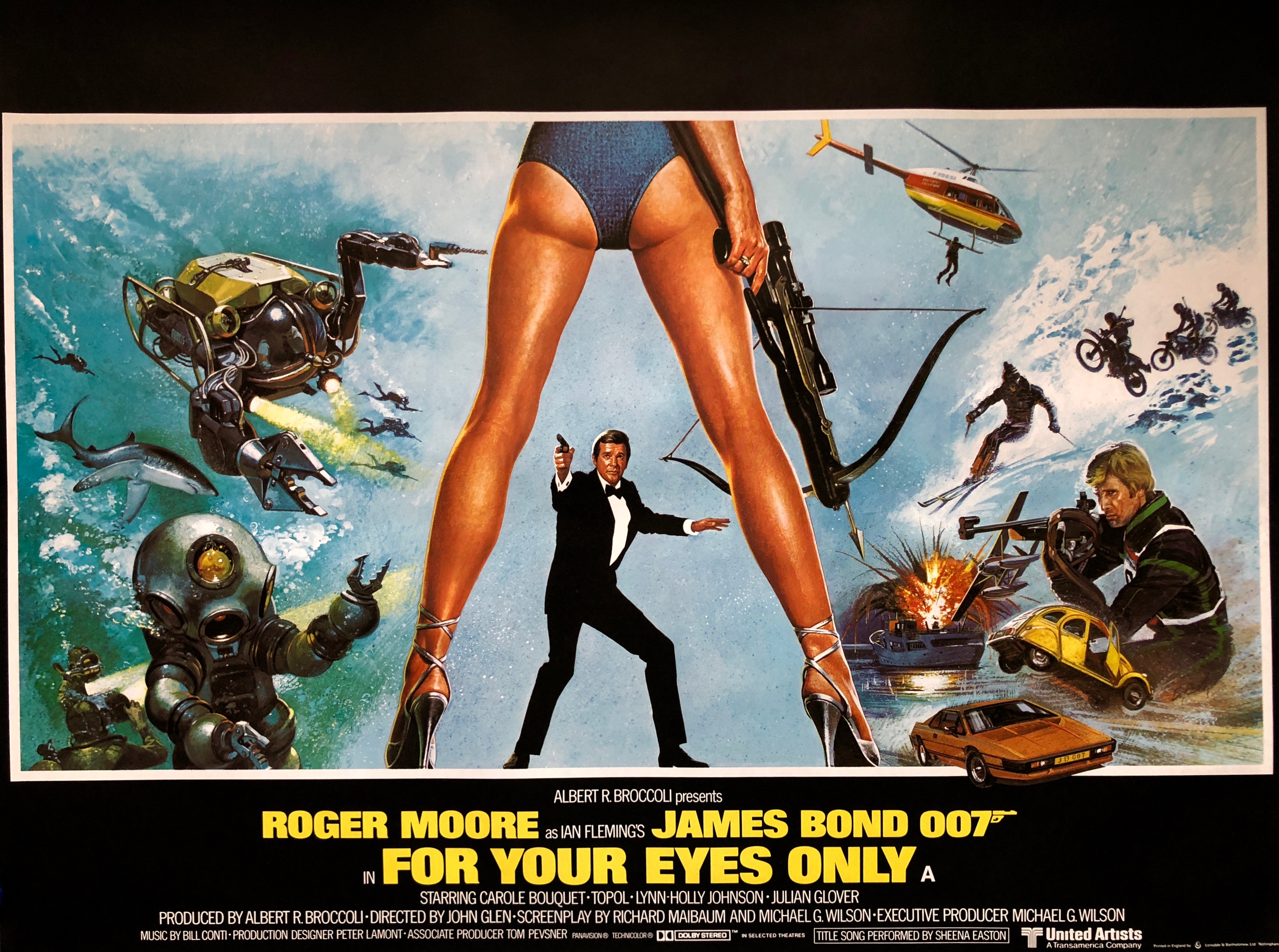
The Bond franchise has also historically relied on women in their extra-textual materials and marketing strategies. For instance, in the first four decades of the franchise, scantily clad women are featured on Bond movie posters in sexually suggestive poses as well as touching or looking at Bond in a longing way. These posters simultaneously convey and confirm the heroic masculinity of Bond who is presented as gentleman (via tuxedo) hero (via holding his gun) who is also desired by a bevy of beautiful women (i.e. the lover).
Playboy magazine was also frequently used to promote the franchise and since 1965 has (un)covered many of the Bond films with special issues like “007 Oriental Eyefuls” for You Only Live Twice (Gilbert 1967), “Vegas Comes Up 007” for Diamonds Are Forever (Hamilton 1971) and “Women of 007” published in conjunction with The Living Daylights (Glen 1987). These photo spreads not only help to confirm the male gaze and emphasize the pleasures of looking at the women of Bond (see Hines 2018), but they also offer the consumer a glimpse of what Bond gets to see behind closed doors as the film themselves do not feature nudity. The franchise has expanded beyond Playboy and utilizes other men’s magazines in its marketing of Bond women in various stages of undress.
Overall, the Bond franchise has historically relied on women and especially the aesthetic ideal of femininity to both shape and promote the world of Bond to a presumed male viewership.
For a detailed discussion, see my article with Tyler Johnson on “Properties of a Lady: Public Perceptions of Gender in the James Bond Franchise”
References
- Black, Jeremy. The Politics of James Bond: From Fleming’s Novels to the Big Screen. London: Praeger, 2001.
- Burnetts, Charles. “Bond’s Bit on the Side: Race, Exoticism and the Bond “Fluffer” Character.” For His Eyes Only: The Women of James Bond. Ed. Lisa Funnell. London, UK: Wallflower Press, 2015. 60-69.
- Dodds, Klaus. “‘It’s Not For Everyone’: James Bond and Miss Moneypenny in Skyfall.” For His Eyes Only: The Women of James Bond. Ed. Lisa Funnell. London, UK: Wallflower Press, 2015. 214-223.
- Funnell, Lisa. “From English Partner to American Action Hero: The Heroic identity and Transnational Appeal of the Bond Girl.” Heroes and Heroines: Embodiment, Symbolism, Narratives and Identity. Ed. Christopher Hart. Kingswinford, UK: Midrash, 2008. 61-80.
- Funnell, Lisa. “Negotiating Shifts in Feminism: The ‘Bad’ Girls of James Bond.” Women on Screen: Feminism and Femininity in Visual Culture. Ed. Melanie Waters. Basingstoke: Palgrave, 2011. 199-212.
- Funnell, Lisa. “Reworking the Bond Girl Concept in the Daniel Craig Era.” Journal of Popular Film and Television 46.1 (2018): 11-21.
- Hawkins, Harriet. Classics and Trash: Traditions and Taboos in High Literature and Popular Modern Genres. Toronto: University of Toronto Press, 1990.
- Hines, Claire. The Playboy and James Bond: 007, Ian Fleming, and Playboy Magazine. Manchester, UK: Manchester University Press, 2018.
- Holliday, Christopher. “Mothering the Bond-M Relation in Skyfall and the Bond Girl Intervention.” For His Eyes Only: The Women of James Bond. Ed. Lisa Funnell. London, UK: Wallflower Press, 2015. 265-273.
- Mulvey, Laura. “Visual Pleasure and Narrative Cinema.” Feminism and Film Theory. Ed. Constance Penley. New York: Routledge, 1988. 57-68.
- Patton, Brian. “M, 007, and the Challenge of Female Authority in the Bond Franchise.” For His Eyes Only: The Women of James Bond. Ed. Lisa Funnell. London, UK: Wallflower Press, 2015. 246-254.
- Planka, Sabine. “Female Bodies in the James Bond Title Sequences.” For His Eyes Only: The Women of James Bond. Ed. Lisa Funnell. London, UK: Wallflower Press, 2015. 139-147.
- Piotrowski, Anna G., “Female Voice and the Bond Films.” For His Eyes Only: The Women of James Bond. Ed. Lisa Funnell. London, UK: Wallflower Press, 2015. 167-175.
- Shaw, Kristin. “The Politics of Representation: Disciplining and Domesticating Miss Moneypenny in Skyfall.” For His Eyes Only: The Women of James Bond. Ed. Lisa Funnell. London, UK: Wallflower Press, 2015. 70-78.
- Wagner, Travis L. “‘The Old Ways Are Best’: The Colonization of Women of Color in Bond Films.” For His Eyes Only: The Women of James Bond. Ed. Lisa Funnell. London, UK: Wallflower Press, 2015. 51-59.
 Dr. Lisa Funnell
Don’t forget Bambi and Thumper, who best Bond, until they suddenly don’t/can’t, since if they continue to do so, the movie stops dead in its tracks. They throw Bond into the pool (which seems to be something they do to men, as evidenced by later dialogue), but then cannot dominate in their chosen element. Bond wins because he must, rendering the victory perfunctory/performative–the man goes on, but the women are ambiguously defeated (much like Blofeld on the oil rig).
LikeLike