Dr. Lisa Funnell
Award-Winning Author | Media Educator & Consultant | “Dr 007” | Director of Communications, G-Woman Media

Construction Sites and the (Re)Building of Bond

Co-written with Klaus Dodds
In The World is Not Enough, Bond states that, “Construction isn’t exactly my specialty” to which M replies “Quite the opposite, in fact.” This exchange draws attention to the fact that Bond is a destructive hero who is not only armed with a “license to kill” but also with a “license to destroy.”
Bond makes claims on a range of spaces and his ruination of physical property plays a central role in shaping his heroic identity and professional prowess. While Bond sets out to destroy the villain’s expansive lair (usually in an explosive fashion), he rarely damages cultural artifacts and national monuments. In that sense the demolition and explosive work he engages in appear measured and proportionate. Importantly, Bond is rarely shown causing harm to animals/wildlife and takes care to rescue any person who is associated with him. His explosive capacity is thus targeted and when is he not able to destroy the villain’s lair he takes out specific elements of the villain’s portfolio.
However, as the series progresses, Bond becomes increasingly destructive and his license to destroy is amplified as the films become more action oriented. The Craig era origin trilogy amplifies the damage by setting a number of action sequences in construction zones—spaces that are partially built or destroyed, depending on how you look at it.
In Casino Royale, Bond engages in a parkour-inspired chase sequence through the construction zone of a high rise building in Madagascar. While Mollaka navigates his way over and around various obstacles, Bond rams through and destroys them in the process. This scene emphasizes Bond’s positioning in the Craig era films as a ‘blunt instrument’ whose approach to fieldwork is physical and forceful rather than subtle and nuanced.
Moreover, the construction zone can be read as a metaphor for the character of Bond. Monika Gehlawat argues that the placement of Bond in construction zones “accentuates his own attempts to emerge from underdevelopment” (2009, p.133). Over the course of three films—Casino Royale, Quantum of Solace, and Skyfall—Bond learns how to be a superspy and experiences growing pains as he learns from his physical, emotional, and psychological mistakes. The aforementioned sequence is part of Bond’s first mission after attaining his license to kill. While his desire to capture Mollaka is evident, he lacks the skill set to capture him quickly and efficiently. As a consequence, he ends up killing Mollaka and violating diplomatic protocols leading to his escapades being widely publicized in the media.
As a hero, Bond is a work in progress and this is symbolized through the use of construction sites to bookend Casino Royale. The final action sequence takes place in a partially renovated building in Venice. In her detailed analysis of the “aesthetics of demolition” in Casino Royale, Gehlawat draws attention to the movement and instability of the structure itself:
Stairwells and landings crumble and drop into the floors below and, eventually, into the canal. Light fixtures, balustrades and random objects (as well as people) seem to detach from the context and slide helplessly downward […] All the while the atmosphere of the scene is dark, confused and foreboding. The scene’s liminal quality manifests not only because it occurs in a space that is neither building nor rubble, but also because of the watery world that soon consumes it. (2009, p.137)
Gehlawat argues that this scene, in combination with the aforementioned chase in Madagascar, can be read as metaphors for the broader changes taking place in the Craig era as Bond is refashioned and updated (2009, p.137).

This scene can also be read diegetically. After discovering that his lover, Vesper Lynd, has betrayed him, he tracks her down to the building and fights her captors. Although this space is relatively empty, the construction equipment presents a new danger as it is mobilized as weapons for attack rather than pursuit. Unlike Moonraker, the conflict destroys the structure of the building, which collapses into the water below. Lynd eventually drowns after she locks herself in the elevator and refuses to be rescued. This scene can also be read as a metaphor for Bond as his faith in Lynd has been shaken and his world, much like the building, has come crashing down.

This foundational instability continues into the next film, Quantum of Solace, which opens with Bond transporting Mr. White to be interrogated by M in Siena, Italy. During the examination, M’s bodyguard Mitchell, who is working as a double agent for the Quantum organization, frees Mr. White. Bond’s pursuit of Mitchell leads them to a bell tower that is under renovation. The men crash through the glass on the roof and fall onto the scaffolding where they begin to use building materials as weapons. When Bond gets caught up in a rope, he swings upside down and struggles to reach his gun in time to kill Mitchell. Not only does the construction site increase the tension of the scene (as the viewer questions if Bond has what it takes to get the job done), but it also reflects the instability of M16 as an organization, which has traitors in its midst—first Lynd and now Mitchell.
Skyfall also uses construction zones and equipment to signify the end of the Bond’s origin story. In the pre-credit sequence, Bond uses a backhoe loader to deflect bullets on the train (although he does get shot) and create an opening to enter the train car; Bond can be seen jumping from the boom of the backhoe onto the carriage just as the back of the car is being peeled away. His progress is short lived (pun intended) as he is accidentally shot by Moneypenny and falls into the river below. This sets in motion a resurrection narrative in which Bond rebuilds himself physically, emotionally, and psychologically over the course of the film.

Bond comes across another construction zone while pursuing Silva who has escaped from M16 custody. It is here that Bond discovers Silva’s plan but not before the villain blows up a wall and causes an underground train derailment. Although Bond is a few steps behind Silva, he races through the streets of London as M recites a poem by Tennyson: “We are not now that strength which in old days moved earth and heaven, that which we are, we are. One equal temper of heroic hearts, made weak by time and fate, but strong in will. To survive, to seek, to find, and not to yield.”
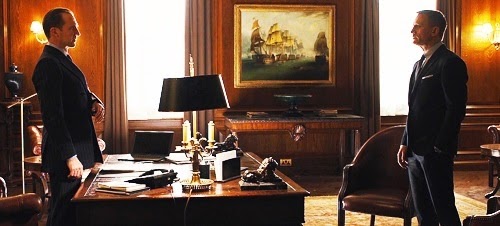
This sequence creates a visual and narrative contrast between Silva, a former M16 agent who deconstructs the system from the inside, with Bond, a hero who shores up the agency from the outside. And in the end, Silva cannot destroy the will of Bond or the ideals of M16 despite destroying part of the MI6 building. In the final scene of the film, Bond enters into the office of M, retrofitted to match the design of the early Bond films. Both Bond and M16 have been rebuilt as the last line of defense for Britain.
For a detailed discussion of Bond’s “license to destroy”, see our book Geographies, Genders, and Geopolitics of James Bond.
 Dr. Lisa Funnell