Dr. Lisa Funnell
Award-Winning Author | Media Educator & Consultant | “Dr 007” | Director of Communications, G-Woman Media

Gendering of Aircraft
Co-written with Klaus Dodds
Bond is a global traveler and sent on missions throughout the world. Airplanes offer the most expedient form of transportation to and from these places. Bond can be seen boarding planes (The Living Daylights), traveling in flight (Goldfinger, 1964), and exiting airports (Dr No, 1962). Bond has fought henchpeople on the runway (Casino Royale, 2006) and in the air (Spectre, 2016), and has been debriefed by allies on the tarmac (Tomorrow Never Dies, 1997). He demonstrates his knowledge of aviation technology by flying various aircrafts (You Only Live Twice, 1967) and has brought wayward planes under control (Die Another Day, 2002).
While airplanes are featured in Bond films, they are not neutral technologies and are bound by social identities – particularly nationality for large airliners and gender for light and small aircrafts.
The airplane serves as a consistent reminder of the Anglo-American special relationship. When Bond flies commercially in the 1960s, his airline of choice is Pan American (or Pan Am). Bond is shown arriving in Kingston (in Dr No) and Istanbul (in From Russia with Love, 1963) courtesy of Pan Am. He is shown travelling again with them in Live and Let Die (1973) on a brand new Boeing 747 and aborts his travel plans with the airline in Licence to Kill (1989).

While Pan Am is associated with the travel plans of Bond early in the franchise, light and small aircrafts (but not helicopters as they were always flown by men with the exception of Naomi in The Spy Who Loved Me, 1977) are feminized and largely associated with female pilots. This is established in Goldfinger with the introduction of Pussy Galore and broadened in You Only Live Twice when the flying technology is explicitly feminized.
Little Nellie is the codename for the gyroplane developed by Q. Bond frequently refers to aircraft using feminine pronouns and even refers to it as “girl”. Little Nellie’s youthfulness – due to her size and newness as a technology – is being signalled through her familial relationship as a daughter with a father/creator, Q.
Language also helps to draw parallels between the gyroplane and the Bond Girl as Bond refers to both as “good girls.” This is notable through his radio transmission following his success in an aerial fight: “Little Nellie got a hot reception. Four big shots made improper advances toward her, but she defended her honour with great success. Heading home.”
The term “girl” has historically been used as a way to diminish, deprecate, and trivialize (grown, professional) women by labelling them as immature or inexperienced. As a result, the depiction of Little Nellie not only aligns her with the Bond Girl (i.e. grown women described as Bond’s girl – see previous blogs) but also emphasizes the patriarchal role that Bond plays via touch. His heroic identity is defined not only through his seduction and domestication of the Bond Girl but also through his mastery of/over feminized technology like Little Nellie.
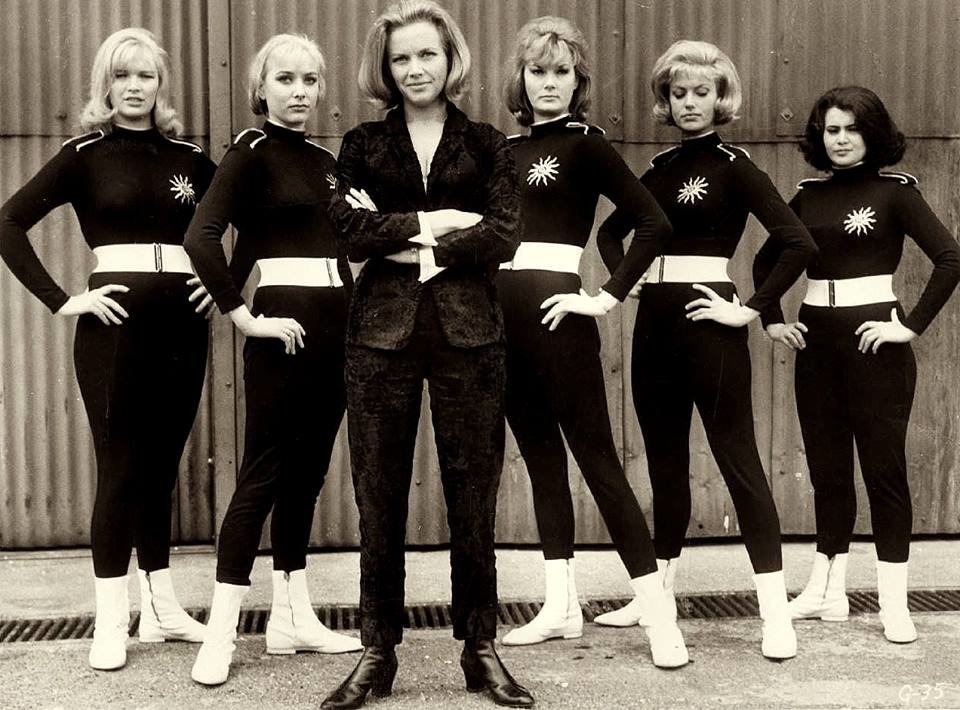
In addition to the feminization of small and light aircrafts, flying is often presented as a female profession in the Connery era and Bond’s ability to seduce a female pilot is a key factor in the success of his mission. This is most evident in Goldfinger as the villain has hired Pussy Galore to be his personal pilot. She is also a flight instructor and the head of an all-female flying troupe comprised of five beautiful women dressed in black spandex uniforms that emphasize femininity and attractiveness. These women will participate in Goldfinger’s Operation Grand Slam by crop-dusting the military surrounding Fort Knox. Thus, Bond’s ability to seduce Galore (and by extension her troupe) away from the villain proves to be the tipping point in his mission. After their sexual encounter, she exchanges gas canisters and works with the CIA to foil Goldfinger’s plan.

Extrapolating from the character of Galore, You Only Live Twice establishes the figure of the personal assistant pilot. Helga Brandt is introduced as the secretary and pilot of Mr. Osato, a Japanese industrialist who is affiliated with SPECTRE. While Brandt is a SPECTRE agent and number 11 in their hierarchy, she works in a supportive role rather than management in the office. Although Blofeld orders Brandt to kill Bond, she is seduced by him and this delays her assassination attempt. The next day, she puts a plan into play that consists of strapping Bond into a small plane and parachuting out, leaving him to die in the crash. After Bond escapes, Brandt is punished for her failure by being dropped into a pool of piranhas where she is eaten alive. As instituted by the Connery era, the seduction of the personal assistant pilot is pivotal to the survival of Bond and the success of his missions, and usually occurs at her expense – professionally and/or personally.
In the Moore and Dalton eras, female pilots are presented as either a personal assistant to the villain and/or Bond Girl pilots who work with/for Bond. For instance, in Moonraker (1979) the scantily clad Corrine who works for Hugo Drax becomes an asset to Bond soon after she gives him a flying tour of the Drax personal estate and space shuttle testing institution. After Bond seduces her, he tricks her into revealing the location of her employer’s safe. After Bond leaves, she is killed by Drax who sends his Rottweilers to chase her down in the forest. Thus the personal assistant pilot is a highly sexualized and disposable object of desire that is killed off as soon as she loses usefulness to Bond and/or the villain.

In comparison, the Bond Girl pilot plays a pivotal role in the success of Bond’s mission. In Moonraker, Dr. Holly Goodhead is introduced as an astronaut and scientist working for Drax. Although Bond initially assumes that Goodhead, like Corrine, is a personal assistant pilot he can seduce, he soon discovers that she is an undercover CIA agent and changes his approach by suggesting that they work together platonically. While Goodhead flies them into space, Bond demonstrates his intuitive understanding of aeronautics and astronautics that allows him to use the technology. And it is only after the mission has been completed that Bond finally seduces Goodhead and their zero-gravity lovemaking session is accidentally transmitted to the base back home.

In License to Kill, Pam Bouvier is presented in a similar way as she is a pilot and CIA agent who assists Bond on his mission. She flies Bond to Isthmus City for the undercover mission and Bond introduces her as his personal assistant, a cover identity that does not go over well with her as she would rather be his boss. Bond tells her that she needs to look the part and Bouvier undergoes a makeover to increase her sex appeal; she returns with a slick haircut and formitting dresses that support her cover as a personal assistant pilot. Although Bouvier offers tactical support in the air, she operates on the periphery of the final action sequence as she flies in a crop-dusting aircraft and remains out of the conflict while Bond performs the majority of the heroic labor by confronting Sanchez in a tanker-truck chase. And like Goodhead, she consummates her relationship with Bond once the mission is complete when he chooses her over his Latin lover, Lupe Lamora.
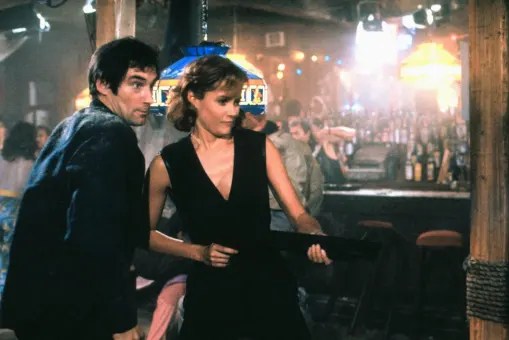
In the Brosnan era, the female pilot is reimagined as a central antagonist through the figure of Xenia Onatopp in GoldenEye. Onatopp is initially presented as being a personal assistant pilot to General Ourmunov for whom she steals the Tiger helicopter in order to transport him to Siberia. This role is suggested through costuming, as she wears revealing clothes such as a low cut dress and a bathrobe, as well as Bond’s interest in seducing her at the casino, albeit with no success. It is later revealed that Onatopp is actually working for Alec Trevelyan and no longer functioning as a potential conquest or tipping point for Bond. This is signalled through a change in costuming as she wears a black military-styled uniform when she abseils from a helicopter to attack Bond. She is subsequently killed when Bond shoots at the aircraft, which leads to her suffocation against a tree. As the last female pilot appearing in the franchise, Onatopp highlights the dangerous role that female pilots play when they cannot be seduced or domesticated by Bond.
The intersection of nationality and gender draws attention to the geopolitical significance of the gendering of light and small aircrafts and the representation of female pilots. Importantly, only American women serve as Bond Girl pilots (Galore, Goodhead, Bouvier) while women who lack obvious national affiliation take on the secondary role of personal assistant pilot (Brandt, Naomi, Corrine). This highlights the central role that the United States has historically played in aeronautics and astronautics, and Bond’s ability to fly helicopters, light planes, fighter jets, and military transport aircrafts helps to counter-balance that aerial/aeronautic dominance. In comparison, the only female antagonist pilot (Onatopp) was once affiliated with the former Soviet Union and the theft of this technology along with Bond’s inability to seduce her, renders her as a genuine threat.
Through its representation of female pilots, the Bond franchise appears to reiterate an antiquated message that was once relayed to American and Soviet female pilots after World War II about the reestablishment of gender roles – they were expected to return to their prewar (domesticated) roles in society. Through his seduction of female pilots, Bond orients them away from the cockpit and toward the domestic sphere with his loving touch.
For a more detailed discussion of planes, trains, and automobiles in James Bond, see my book with Klaus Dodds on Geographies, Genders and Geopolitics of James Bond (2017).
 Dr. Lisa Funnell